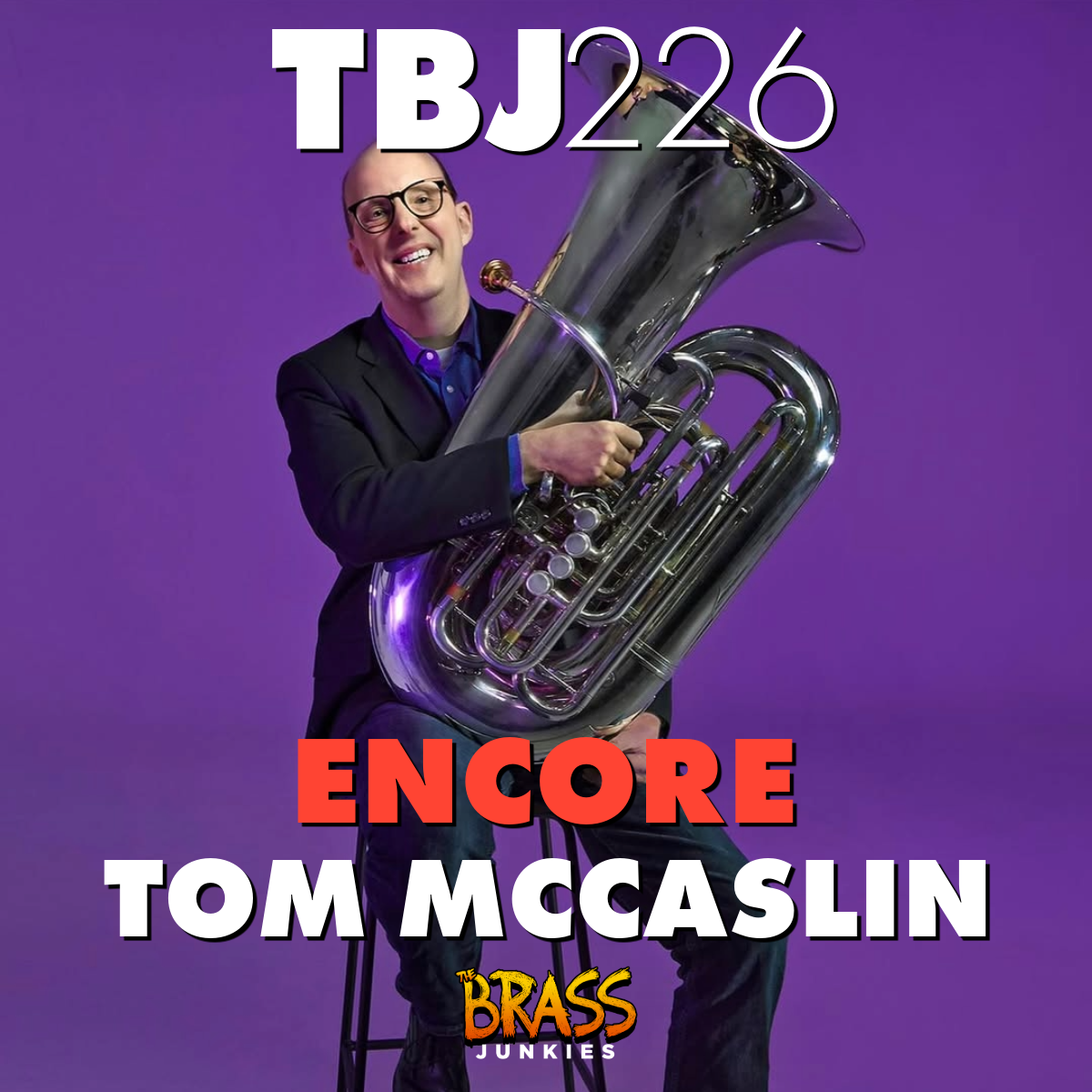
Encore of TBJ85, first released on May 15, 2018, with a new introduction from Andrew
On Christmas Day 2002, with the school locked and the Boston Symphony audition weeks away, Tom McCaslin played two Bach suites for Sam Pilafian in his Arizona apartment, and then Sam taught him how to prepare a turkey. Two seasons into his job as Principal Tuba of the Calgary Philharmonic, Tom walked Andrew Hitz and Lance LaDuke through the 84 hours of practice recordings that helped him win it. He also explains why the best studios he knew were never tuba factories.
+
Read the Full TranscriptHide the Transcript
Andrew Hitz: Hello, and welcome to the latest episode of The Brass Junkies. I am your host, Andrew Hitz, and I'm going to be honest with you, I have tried to record this very brief intro a number of times 'cause I just don't exactly know what to say. Uh, this is, uh, the premiere of, uh, of a new kind of digging through the archives, and it's called an Encore, and, uh, this features the conversation that Lance and I had with the absolutely incredible Tom McCaslin. Uh, this was originally, uh, aired, uh, it was TBJ85, which was, uh, first premiered on May 15th, 2018, so coming up on 10 years ago. Uh, Tom tragically passed away a couple of years ago, and, uh, Lance of course passed away a few years ago as well. And, uh, Tom, actually all three of us, uh, speak pretty extensively about Sam Pilafian, uh, in this episode, and he, of course, is no longer with us. And so, uh, it's really bittersweet. Uh, the fact that all three of them are no longer here, um, is just absolutely heartbreaking. Uh, but, uh, as you're about to hear, uh, Tom was this amazing spirit, as was Lance, of course, and, and, uh, you know, they, they live on.
Um, in fact, to tell you how much fun we had, uh, recording this one, um, the program that I use to transcribe, uh, old and actually new episodes, it can automatically, uh, detect how many voices there are, and it then plays a short clip, and then, uh, you tell it what the name is, and then it inserts it into the transcript, and it's actually amazing how fast it is. Um, and it came up with four. One was me, one was Lance, one was Tom, and then there was a fourth one, uh, because it came up so many times in the interview that the three of us were all laughing hysterically. And, uh, so it actually thought that there was a fourth person, so we confused the machines.
Um, but we really just, uh, had a, a wonderful time talking to Tom about him auditioning, uh, for, uh, for the Calgary Philharmonic. Um, yeah, about him making some albums with Sam, about, uh, both of us talking about studying with Sam. Um, yeah, just some really, really special memories. Um, I miss all three of them, uh, desperately, but I'm, I feel really, really, uh, a lot of gratitude, uh, that, uh, that this exists and that I get to, uh, to relive, uh, all three of them through it. So I really, uh, hope you enjoy this. Without further ado, uh, here is an encore of the conversation that Lance LaDuke and I had with Tom McCaslin.
Andrew Hitz: Hello and welcome to the latest episode of The Brass Junkies. I am your host, Andrew Hitz, and today I am joined by my American colleague, Lance LaDuke. Lance, how are you today?
Lance LaDuke: I'm doing great, A. Thanks for asking. I appreciate it.
Andrew Hitz: Yeah, today, today's guess is g- today's guess?
Lance LaDuke: Guess.
Andrew Hitz: What's your guess?
Lance LaDuke: It's anyone's guess.
Andrew Hitz: Today's guest is a, is an impossibly friendly human. I'm struggl- I'm struggling with English here. That's, uh- Words ... that's good. It, uh- Words, words, words ... it's not like we have another inter-
Lance LaDuke: Words, tuba words ...
Andrew Hitz: we, we, we do have another interview right after this. Awesome. So today's guest is Tom McCaslin, who is the principal tuba of the Calgary Philharmonic and is impossibly friendly.
Lance LaDuke: Truth.
Andrew Hitz: He's, like, impossibly friendly. He's a complete and utter badass as a soloist, as a jazz player, as a, uh, as an orchestral player, as a teacher, and, uh, yeah, and he's just, he's, like, a humble dude.
Lance LaDuke: Humanitarian, gardener. Um, man about town, tailor Um. Key grip
Andrew Hitz: T- Taylor. Yep, he's, uh, yeah, he's-
Lance LaDuke: Phrenologist.
Andrew Hitz: He's a bad mofo with a sewing machine, let me tell you. So, uh, y- yeah, this is a great episode. I really, really enjoyed, um... Well, I guess I, I, we should record the intro before I declare it a great episode. So since I'm a little punchy. So yeah, I had juries yesterday. You had juries. Yep. I also hosted the banddirector.com online stream from Illinois Superstate, which was two 13-hour days in a row on Friday and Saturday, and, uh, traveled a Sunday, juries and paperwork all day yesterday.
So, and now here we are this morning, and so, yeah, I'm a little punchy.
Lance LaDuke: Juries and paperwork is a really bad country song idea.
Andrew Hitz: Yeah.
That's, see, that's how punchy I am. That really wasn't that funny. I mean, it was, like, kind of funny- I'll take it ... but I laughed like it was really funny, and, and it, you know, it just wasn't. But I digress. So we need to thank Parker Mouthpieces- Ooh ... for providing the hosting to, uh, I almost said TEM. What the hell podcast am I on?
Lance LaDuke: Hmm.
Andrew Hitz: I don't know either. Uh, Parker Mouthpieces offers fine customizable- Oh, wow ... component mouthpieces for horn-
Lance LaDuke: Those
Andrew Hitz: are nice ... trombone-
Lance LaDuke: Ooh ...
Andrew Hitz: euphonium- What? ... which is similar to a baritone, and tuba- Nice ... including the Andrew Hitz artist model tuba mouthpiece and- Ooh ... the Lance LaDuke model euphonium mouthpiece.
Lance LaDuke: Hmm.
Andrew Hitz: You can find out more at parkermouthpieces.com or follow them on Facebook, Instagram, and Twitter. Twitter. Hey, everyone should go and send Mike Parker an email and say that you keep hearing that, uh, he has euphonium mouthpieces available, and ask him when he's gonna have baritone mouthpieces available.
Lance LaDuke: Good idea.
Andrew Hitz: Seems like everyone should go to parkermouthpieces.com and hit on contact, and then, uh, and then send, uh, send Michael an email. So-
Lance LaDuke: And ask if he has double bell euphonium mouthpieces, and if they come with two different cups.
That's a good idea right there.
Andrew Hitz: That's pretty... Seems like we should send everyone on a, uh, on an email Michael Parker journey each week. I think you're right. That's
Lance LaDuke: a- Or each new feature.
Andrew Hitz: So this week, let's only ask him about the baritone. We'll do double bell next time. All right. Fair enough. So yeah,
Lance LaDuke: that's- Baritone
Andrew Hitz: only
that's good. There we go. And I'm not gonna tell him this, 'cause in- if he's not- if he doesn't listen, I'm just gonna, I'm gonna eventually get a, uh, text like a WTF, so that would, uh, that'd be good. So, um, all right. And we need to, uh, yeah, Pappert people.
Lance LaDuke: Pappert people. Thank you very much to the Mary Pappert School of Music at Duquesne University in beautiful and sunny Pittsburgh, Pennsylvania for supporting this show.
You can find out more about what is happening in the brass area at Duquesne University, uh, by clicking on the link below. And actually there's, uh, um, the news, if you haven't heard it, is that I am officially done at Duquesne, and a fantastic Lithuanian young, uh, euphonium soloist and teacher named Algirdas Matonis, who recently completed a, uh, degree with me at Carnegie Mellon, is taking over the euphonium studio.
And James Gourlay of the River City Brass and Philip Jones and a bajillion other really cool things is, uh, picking up some tuba students and running the tuba ensemble. So you can find out more about the goings on going on by clicking on the link below. And very, very, very, very, very special thanks to Jim
Uh, Jim, let's see. Jim, that stain's never coming out Nova. No? I don't
Andrew Hitz: know. I'm still laughing at-
Lance LaDuke: You still- ...
Andrew Hitz: you called him Bubble
Lance LaDuke: Butt ... Bubble Butt. And I saw him and he said people were giving him a hard time, and then I apologized, and then I saw him again, he was like, "They weren't really upset. You didn't have to apologize."
So sorry, but that stain's never coming out.
Andrew Hitz: That I- if I remember correctly, you were once, uh, te- test driving a car-
Lance LaDuke: That's
Andrew Hitz: right ... or you were with someone who did, and the g- and the- Oh, excuse me ... the car salesman said, "Do you have any more questions?" And you said
Lance LaDuke: Uh, how do you get blood stain out of carpeting?
A- and actually, the other person in the car with me is my now boss, uh, who was my then boss with the River City Brass, Denis Colwell, who's the head of the school at Carnegie Mellon. He was in the backseat. And, uh, yeah, the guy was- Oh ... he didn't quite know what to do about that.
Andrew Hitz: That's pretty good.
Lance LaDuke: And that was actually- That's pretty good
the same, uh, uh, we- I test drove a Ford, and the guy said that it had eight cup holders in it, and Dennis said, "Well, with eight cup holders it should come with a, a, uh, port-a-potty." And the guy was like, "No, I don't, I don't think they're gonna come with a port-a-potty." And I said, "You know, Ford has this r- um, these SUVs.
There's the Ford Escape, and then the next one up is the Explorer, and then there's a bigger one called the Ford Excursion." I said, "Ford should have one that's even bigger than that." I swear to God I said this to this guy. "They should have one even bigger than that and call it the Ford Excessive." And he said, "No, I don't, I don't think...
I think that the, the Excursion's gonna be the biggest one." I said, "Okay. Thank you. Good luck to you, sir."
Andrew Hitz: So you had an automaton is what you had.
Lance LaDuke: I did. That is very funny. That's awesome. Thank you for your time. Will you buy a
Andrew Hitz: Ford? I don't think we've ever done that for another customer, but I will check with my manager-
while I actually just go smoke a cigarette.
Lance LaDuke: That's pretty good.
Andrew Hitz: Oh, I love car salesmen. So they're- Mm-hmm ... they're, they're great. So.
Lance LaDuke: Yeah.
Andrew Hitz: All right. Well, do we have anything else before we- Yeah, we do.
Lance LaDuke: We do.
Andrew Hitz: Um, and also for everybody that's gone to iTunes and left us a rating and a review, thank you.
We are really close to our goal of 100 ratings. We are at 97 ratings right now. So we are- Come on, people ... yeah, three more people just take, like, a moment to go to iTunes. There's a link in the show notes. And we're also at 55 reviews, which are, uh, which it's, it's amazing if you can leave both, so. Um, so yeah, so thank you to everybody who's taken the time to, uh, leave us a rating or review on iTunes, and also to anybody who has shared it with a friend or posted to social media or, um, yeah, it's, uh, we, we really do, uh, appreciate it.
So I think that now we're actually done.
Lance LaDuke: I think you're right.
Andrew Hitz: Yeah, I think so. So all right. Well, without further ado, let's get to our conversation with Tom McCaslin of the Calgary Philharmonic.
Today on The Brass Junkies, we are joined by Canadian wonder tubist, Tom McCaslin. Tom, how are you?
Tom McCaslin: I am fantastic, Andrew. How are you?
Andrew Hitz: I'm great. How is the weather in Calgary currently?
Tom McCaslin: It is a beautiful, beautiful day. Um, 70 degrees out, um, for you Americans. Um- ... mid-20s for us Canadians. Um-
Andrew Hitz: I was gonna say, I'm pretty sure it's, like, the 70s for anybody, but-
Tom McCaslin: No, just, just for you Americans.
Andrew Hitz: We always make, we always make people from other countries feel incredibly welcome here, so, um, so I would expect the same treatment from you. It's, it'd be pretty, pretty good if you could actually change the weather for Americans. That's pretty good. Hey, you know what I just thought of, Lance?
Lance LaDuke: No, I do not, Andrew.
Why don't you tell me what it is that you just thought?
Andrew Hitz: I just th- I just thought of, I don't even remember what... Uh, what was the city that we were in, uh, in Ontario, right on the water that was- Oh ... uh, across from, right across from Michigan. Yeah. And we had, we had a gig and, um, and anyway, one of our one of our- Across the port
Lance LaDuke: here on
Andrew Hitz: one of our band mates, um, may, may or may not have, um, have accidentally left his suit coat in Canada. Oh. And it was like... Yeah, it was like you could have swam there in 45 seconds, but he had to, uh, wait in line and then explain that he had to j- just go, like, two blocks and, yeah, it was a, it was a big ordeal.
And in a road band, you root- Sarnia.
Lance LaDuke: It was Sarnia.
Andrew Hitz: He was like... Yes. Sarnia.
Lance LaDuke: Sarnia. It's a reason for entrance into Canada to get my pants.
Andrew Hitz: That was it. It was pants. You're right. It wasn't coat, it was pants. Yes. It was like coat you could just, like, let's just do no coats. But you can't be like, "Hey guys, can you do me a favor?
Can we go no pants?"
And in a road band, after a while, and by after a while, I mean, like, a week, like, you start rooting against each other. Um, you know- ... not, not like actual harm, but it's like, that's awesome that my band mate is really upset because he left his pants in Canada. So yeah, it's, it's, it's, it's kinda, it's kinda terrible, so.
I mean, Lance wasn't that way. He always maintained a positive attitude, didn't you, Lance?
Lance LaDuke: I absolutely did.
Andrew Hitz: All right. Enough about Tom. Let's talk about our road stories some more. Um, so so- The lesser-known
Lance LaDuke: Tony Bennett tune, I Left My Pants in Sarnia, Canada.
Andrew Hitz: There you go. Has the, has the Calgary, has the Calgary Phil ever played that, uh, Tony Bennett tune, Tom?
Tom McCaslin: Um, I haven't been on that gig, if it's, if it's appeared. It'll probably come around soon enough.
Andrew Hitz: There's
Lance LaDuke: a huge tuba solo in that one.
Tom McCaslin: I bet.
Andrew Hitz: Yeah. And it says right in the score you're supposed to not wear pants, so yeah.
It's, uh, which is, which is like hosting a podcast. But anyway, uh, so, uh, how long have you been the principal tuba in the Calgary Philharmonic?
Tom McCaslin: I am about done my second season here in Calgary.
Andrew Hitz: And you are from Canada originally.
Tom McCaslin: I am originally from Regina, Saskatchewan, Canada, which is one province over- Come again?
Yeah, I said it. Regina, Saskatchewan.
Lance LaDuke: Oh, no, I missed the Saskatchewan part.
Tom McCaslin: Oh, my bad.
Andrew Hitz: Isn't Saskatchewan where, uh, Pete Meechan lives right now- Uh- ... Lance? Or Tom or anybody? He did- I don't assume that you know him just 'cause he's Canadian, but, you know- Yeah ... it's like, it's brass circles, so there's- ... there's a couple of overlaps there in the Venn diagram.
Yeah.
Lance LaDuke: I know a Canadian. Do you know him?
Tom McCaslin: Pete was living there, but he now lives in Winnipeg, uh, Manitoba.
Andrew Hitz: Oh.
Tom McCaslin: Yeah.
Andrew Hitz: Home of the Jets. There you go. That's right. There you go. So he's, so he's, like, moving around. Look at him. He's all, like, metropolitan now in Winnipeg.
Tom McCaslin: That's right.
Andrew Hitz: There you go. So, um, yeah, have you ever, uh, I'm, I'm gonna rephrase this.
Not have you ever, how many times have you had an American say, "Oh, you're from Canada. Do you know my friend blank?"
Tom McCaslin: Many times. Um- Yeah. ... you know, um, although I'll say- They're just
Andrew Hitz: not that bright.
Tom McCaslin: You have to
Andrew Hitz: be patient ...
Tom McCaslin: in the, in the music world, however, it's not that uncommon for me to actually know the person that they're talking about, um-
Andrew Hitz: Sure
Tom McCaslin: especially, uh, musicians that have spent time in the States, either at schools or festivals, and, and the brass world is, is super small. Um, but, uh, yeah, for, like, regular friends, uh, yeah, it's, it's, uh, you know, it's a pretty wide country, you know?
Andrew Hitz: When I was in high school, uh, I was in a wind ensemble, and one of the, one of the kids...
Uh, we- no, we did an... We were in Japan, and we did, like, we were doing a side-by-side with, uh, an international group, and, uh, one of the tuba players was from Canada, and one of the tuba players in the group I was with said, "Oh, you're from Canada. Is it cold there?" Which, which was, uh... And, uh, and this guy was, you know, he was Canadian.
He was friendly. He said, "Sometimes." Sometimes. Yep. That's,
Tom McCaslin: that's pretty accurate, yeah.
Andrew Hitz: I think I took over for him. I was like, "You dumbass." It's like- ... dependent. Come on. Come on. Let's, let's try a little harder here. So, um, what was it like winning a major gig like that back in your home country?
Tom McCaslin: Um, exhilarating, I guess is probably the word that comes to mind.
Um, and a little bit of relief. Um, been taking auditions for a long time, and so to have finally gotten to the very end and, and being the person called, along with it being in, uh, the country I'm from and in a city where my brother lives and I have family, uh, very close- Hmm ... um, it all just sort of came together, and it was, uh, yeah, it was fantastic.
One of the, one of the best feelings you're probably ever gonna get.
Andrew Hitz: Hmm. Did you, did you play better than you usually did, or did things just fall right, or was it a combination of the two? Or what was your take on, on, uh, on how things went down?
Tom McCaslin: Um, well, I mean, I certainly felt great, uh, with how I played.
Um, I think the, the last couple auditions that I had taken, um, had created a, a little bit of momentum and a ramp moving forward. Um, but I really think the, the big difference was how I prepared for it, and I think my, my preparation for that audition, um, was as good as any audition I've, I've taken, probably going back to the ones that I was preparing, uh, while I was at Arizona State and, uh, studying with, with Sam Pilafian.
Um, so yeah, it was-- I, I felt good with it, with every round that I played and, uh, and was very comfortable. Um, but it was a, a long process to get there, so it wasn't like, "Oh, I got lucky today." It was, it, it was a lot of work.
Lance LaDuke: How would you say your audition prep evolved over the years to, to this peak? Like, what were the kinda key, um, stepping stones?
Tom McCaslin: Well, the, it-- I didn't have success, the kind of success I really wanted, uh, on my own when I was finished with grad school until my ears got a lot better. Um, I, I had the benefit, um, when I was studying, uh, with, with Sam during my master's degree, um, of taking six auditions in two years. Um, and during the summers, I, I was the Tanglewood Fellow, and so auditions were sort of what was happening at, at that time, and I took every opportunity.
And basically Sam, um, was my ears, and, and he was telling me what to fix and what to change, uh, in, in two lessons a week. And then I left grad school, um, and I sort of took a step back, and it took a while before, um, my ears caught up to where I could really hear everything that needed to be changed and fixed, um, and could also hear what was going well and what I didn't have to spend time working on.
Um, so by the time I got to the Calgary audition, um, I really put a premium on recording everything that I played, uh, in, in preparation for that audition. I, I think I have 84 hours of, uh, recordings on my hard drive somewhere, uh, of all the sessions that I did leading up to it, and then I would listen to all those sessions and, and make notes.
And I, I think th-that's sort of what was peaking, that I could actually hear what needed to be fixed and then attempt to, to do that.
Lance LaDuke: What, um, level of-- there's a, there's an implied level of trust or faith in these are things that I know that I can do. I think young players are resistant to, uh, I, I should just touch this thing again.
Even though I know I can do it, I should touch it again, touch it again. Right. And s- instead of just having the faith. W- uh, did that come naturally to you? Is that another thing that you developed? Or is, or what, what, what's your take on that?
Tom McCaslin: Yeah, trust is a funny thing when it comes to, to playing a musical instrument.
Um, and there's always that, that hesitation backstage, like to pick up the horn one more time to start whatever excerpt or, um, whatever piece, just so you have that, um, confidence that, that it's gonna be there. Um, so th- that takes a long time to get rid of. I'm not sure I completely, uh, am away from that. I mean, I think there's always that, that little voice that, that wonders i- is it gonna be there when it, when it needs to be.
Mm-hmm. Um, but I, I do think that, that putting yourself in motion, um, taking a good breath, and always using the, the same proper mechanics with playing starts to sort of get rid of those thoughts in your brain, and you start to think about music, uh, you know, to move ahead. So no, I think that's something that I still struggle with, uh, honestly.
Um, however, I mean, I-- in, in, in listening to all the preparation stuff that I was doing, um, I, I would focus more on the negatives than, than the positives. Um, so, you know, listening for time, listening for intonation, and then spending a lot of time tweaking stuff, um, so I wasn't just repeating what, what felt good in the practice room.
Lance LaDuke: Mm-hmm. Was there a particular system that you were using, or you just sort of was just, you know, get back in there and peel back another level?
Tom McCaslin: Well, I mean, I, I guess it sort of developed into my, my own system. Uh, when I was preparing for auditions with Sam, uh, the, the big audition that was announced right when I started my master's degree was, was Boston, and I had done the Tanglewood Music Festival the summer before.
Um, and so obviously that was like the dream job, uh, being out at Tanglewood and hearing the, the BSO, um, every week, uh, was like, "Okay, that's, that's the gig I, I really want." And so when we started preparing for that audition, um, we made cards of all the excerpts and basically divided everything into, into two groups, um, excerpts that I was still learning, and then excerpts that I was ready to perform and tweak.
And I think, you know, the first couple weeks that we did that, there were no excerpts in the ready to perform yet. Um, so I would play the excerpts down and we would-- he would make notes about what needed to be changed and, um, improved upon, uh, in e- in each excerpt, and then I would go to work, and then over time, the-- everything went from the B list to the A list, um- Mm
and then, um, I sort of took that, uh, same, same philosophy, um, and then as, as the audition got closer, uh, I found a randomizer app that's designed for teachers, uh, so they can call on every student equally. Um, and I, I, I put all the excerpts in that app, and then I would play different permutations of, of rounds, uh, of excerpts, uh, in, in my practice sessions.
Um, sometimes I would do, uh, groups of five or, or groups of four, and then sometimes, uh, getting closer to the audition, I would do longer rounds of, uh, uh, of excerpts, like seven or eight, to sort of duplicate what you'd be expected to play in a final round to, to build up, uh, some more endurance. Um, so yeah, it sort of evolved from that.
I know M-Mike Roylance has a similar system, um, that involves putting random excerpts in different envelopes, sort of with that same idea that this is your most likely, uh, set of excerpts that you're gonna have to play, followed by excerpts that, you know, aren't asked, uh, as often, so... And, and with a tuba audition, there's so few excerpts that come up that it's pretty evident which excerpts you really, really have to know well, uh, for, for every audition.
Lance LaDuke: We were in, uh, I had juries yesterday at Carnegie Mellon and there were five of us on the panel, and somebody, it was a trombone player, brought in a list of excerpts and, uh, her teacher, Becky Cherian, was like, "Well, um, let's pick these in a random order." And, uh, just sort of by chance, the first guy, we were getting punchy as well, that didn't help-
picked the first, the first excerpt that was listed. And then just to be a dink, then the second person, like, picked this. So we actually just went down the list, which was kind of perfect because she was 100% sure that was the only order she wasn't going to play them in. Kind of fried her head a little bit.
Wait a minute, what?
Tom McCaslin: That's great. I, I would also do a, a round almost every day of what I considered to be the most likely first round excerpts. Um, you know, so for a tuba audition, that's "The Ride of the Valkyries," "Meistersinger," Mahler One, "Hungarian March," Prokofiev Five. Um, I'm not sure there's an audition I've taken where I haven't had to play those excerpts.
Um, so I really wanted to make sure that those excerpts were the best, um, out of the bunch. Like, I wanted to have the best Ride at the audition. I wanted to have the best Meistersinger at the audition. Um, you know, not that I didn't want anything else not to be the best, but I mean, I really wanted those to stand out.
Um, so yeah, I was, I was pretty determined, I guess.
Lance LaDuke: Let's, can we go back to the, the mental prep a little bit more? Sure. And do you, do you, you use some sort of, um, talk method or are you... It sounds like, I mean, you mentioned that you, you initiate some sort of physical thing to kind of override any chatter that's going on in your head.
Yep. Um, do you do anything else like that or is it, is it, is it a phys- is it always a physical thing or what else is in the, uh, the toolbox there?
Tom McCaslin: Well, I mean, the, the day of the audition, um, and, and I've learned this for myself over time that I, I need to sort of put myself in a cocoon. Um, and a lot of players at auditions take that opportunity to play, um, catch-up time with friends they haven't seen for, for a while or, you know, to be very social.
Um, and I just, I just don't play well in that circumstance if I'm being overtly social s- and I've learned that over time that I have to just basically put myself in a silent place. So I take-
Andrew Hitz: You're also not very personable.
Tom McCaslin: No, no. I mean, I g- I generally hate people, so, um. It, it makes that part easy I guess.
Um-
Andrew Hitz: Super hard to get along.
Tom McCaslin: But I would, I would take noise-canceling headphones and just sort of sequester myself, um, wherever I could in, in either the green room or the, the, the warmup room that they give you, um, to basically be in my own space, um, to know what, you know, to control as much as I can about my mental state.
I think I find when, when I'm being social in, in, in that highly elevated, um, environment, uh, that I need to have more control over what's going on through my head. Um, so yeah.
Lance LaDuke: Well, so then what do you curate, I mean, so now you have silence and then do you curate the, I mean, do you listen to music or do you, uh, just sit in the silence?
And then if you do, then what, what's going on in your head? You've, you've blocked everything, you've blocked the external distractions- Right ... out but what do you do about the internal distractions?
Tom McCaslin: Yeah, I mean, I, for Calgary I was listening to sports podcasts. Um, big fan of the Bill Simmons podcast so I was, I was listening to that backstage.
Um, and, uh, music. Um, yeah, just a l- a lot of pop music. Uh, stuff that's, you know, not related to the, uh, the task at hand at all. Um, so when it's go time then I can just sort of, um, you know, go for it and not be analyzing it the, the entire time I'm, I'm waiting to go.
Andrew Hitz: Makes sense.
Tom McCaslin: Yeah.
Andrew Hitz: Yeah, it does.
Tom McCaslin: Yeah, it's funny- Yeah
because I, I know players that, that listen to um, excerpts or classical music in the car all the time. Um, I'm either listening to, to podcasts or sports talk radio or nothing at all, um, when I'm driving to and from the hall, uh, to sort of prepare myself to perform at, at the highest level. Um, and that's, that's just sort of, I mean, the thing that I've discovered over time that I need to do is like I just need to clear my head to be able to, to engage it at the highest level and, and concentrate.
And, uh, I have a hard time not analyzing stuff that I listen to because that's, you know, part of my job.
Lance LaDuke: Yeah.
Tom McCaslin: Um- Right ... so if, if I'm putting my ears in that space, then I'm not as concentrated when I'm going to perform, I guess.
Lance LaDuke: Well, it goes back to the trust issue. Yeah. I mean, at, at the point that you're driving to the audition or to the concert, if the preparation isn't done, there's no amount of worry that's gonna help you all of a sudden be prepared.
Tom McCaslin: Correct. Yep, that's, that's exactly right. You're not gonna be able to, to think of the magic, uh, you know, solution on, on the way to, to the gig. I mean- Oh ... it is what it is ... second
Lance LaDuke: and third valve.
Tom McCaslin: That's right.
Lance LaDuke: That's what I've been doing wrong.
Andrew Hitz: One more listen to the, uh, to the Gene excerpt CD, and you're gonna finally figure out, like, what the note weight should be for Prokofiev 5.
Tom McCaslin: Yeah, I've been listening to that CD for 20 years, and I still haven't figured out all the
Andrew Hitz: secrets. Can you, uh, so that's... First of all, I wanna put in a plug, and we're gonna put this in the show notes, is that, um, uh, many moons ago when I taught at George Mason University, I had a, a graduate, a euphonium major who, uh, Boston Brass was, uh, was, was at Mason.
We were rehearsing. I think we played a concert too. But anyway, um, Lance agreed to give, um, this kid a lesson. He was a, a graduate performance major. And, um, and, uh, two minutes in it was like gold, so I actually pulled out my phone and, and recorded the rest of it. And, um, the sound quality isn't great. It's totally passable, but I threw that up on my personal SoundCloud page, which has almost nothing on it.
But, um, it's like a 45 or 50-minute talk that Lance gave to this kid on how he prepared for the Air Force Band audition. Oh,
Tom McCaslin: very cool.
Andrew Hitz: Yeah, it's really cool. Um, Lance, we should maybe even release that sometime as like a Brass Junkies episode. Oh, yeah. I could do that. Yeah. Or a bonus thing. Yep, exactly. But, um, but if you are preparing for auditions, you need to go and check this out because it's, um, uh, none of the specifics were the same as what Tom just said.
Um, and Lance goes, goes deep 'cause, you know, that, that's what I asked him to do. But, um, but it's the same thing. I mean, it's like the just really, really i- intentional. That's the word I always come back to with the most successful people in our industry, either entrepreneurs or people with auditions or, uh, whatever.
Um, but it's just, you know, like your system and just what you executed. You weren't just, you weren't just working hard. I mean, yes, you were working hard, but it sounds like you, from day one, you had a plan, and then you even had the self-awareness to recognize that after you left grad school that you took a little bit of a step backwards in terms of how clear your plan was.
Um, and then had the self-awareness to identify that and then to tweak it and then to get just as good if not better than you were before, and then kept getting close. And, you know, I hear somebody talk- you know, lead us through what you just did, and it's like, well, yeah, and I wasn't, so you're, you're one of the best tuba players I've ever heard.
Is- and solo-wise, you're just r- it's stupid what you can do. Um, but so I wasn't surprised when I heard that you won the audition, but you hear you talk about your, your process, and it's like, well, yeah, I don't think anybody listening's like, "Oh, so he got lucky." I mean, you know, it's like, it's, uh, yeah, that, it, it's, I love getting under the hood- Yeah
like that, even though I'm never... I took one orchestral audition, the Oregon Symphony. I didn't advance. I was young, and then I took one brass quintet audition, which I won, and that is the last audition I'm ever taking. Wow, good for you. So, um, so it's not, you know, it's not, uh, yeah, so I'm just like, you know what?
I'm not gonna be, uh, hanging out in the orchestral world for a total of, like, three to four weeks a year and then go and beat Tom McCaslin and Aubrey Foard, and, uh, you know, and, and Seth Horner and Seth Cook and all of you guys. Uh, that's not gonna happen. So, but it's still fascinating for me to hear the process that goes into you guys winning auditions, so thank you for sharing that with us.
Yeah.
Tom McCaslin: Yeah,
Andrew Hitz: thank you. Can you talk a little bit more about studying with Sam and what, uh, and what that was like?
Tom McCaslin: Yeah, I mean, it's, it's life-changing, and I think that Sam has this ability to, to bring the best, um, out of everybody and, and to provide some, some clarity with, with younger people, I mean, m- m- mainly college kids, um, with, with where they wanna go with their, um, with their passion and with their art and with their music-making.
Um, I first heard Sam, um, when I was in high school. My dad, uh, was a brilliant businessman and, and traveled a lot, um, when I was a kid, and, uh, when I was in high school, he started bringing me back CDs. Uh, he frequently would go to Toronto, and at the time, Toronto had one of the only really big music stores in Canada that had a selection of music where you could find tuba CDs.
Um, and so my dad came back from a business trip, and he had, uh, found Sam's first Travelin' Light CD. Um- Nice ... and so I put that on, and it was just life-changing. I mean, I, I had heard Roger Bobo solo CDs before, and I'd heard some Harvey Phillips things, and I studied with an amazing tuba player in high school, but I had never heard someone play jazz like that on the tuba.
Um, and I was just absolutely blown away. Um, so I was hooked for life. You know, I, I knew I wanted to, to pick that man's brain and to hear more and just to soak up everything that, that he had to offer. Um, so I came close to going to Arizona State, uh, for my undergrad, um, but that didn't, didn't work out for, for financial reasons.
Um, they had a, a marching band scholarship, and I just didn't wanna have to be in marching band. Um-
Andrew Hitz: What year would that have been?
Tom McCaslin: Uh, 1997.
Andrew Hitz: I would have been your teacher, one of your two teachers- Yeah ... if you had come then. That, yeah, that I, I would've had so much to teach you.
Tom McCaslin: Well, and I- So
Andrew Hitz: yeah ...
Tom McCaslin: I, I know that the story goes that Deanna was listening through, um, audition tapes that were sent to Sam.
Um, and I, I didn't audition live, I sent a tape. Uh, it was a long- Mm-hmm ... to travel from Canada, and I know that Deanna listened to the tape one night, uh, I think with Kelly Thomas if, if he was there at the same time as you were, Andrew. He,
Andrew Hitz: no, we bo- we both got there in the fall of '97.
Tom McCaslin: In the fall of '97, okay.
Andrew Hitz: Mm-hmm.
Tom McCaslin: Um, and anyways, then Deanna told, uh, Sam about the tape, then he listened to it, and then he gave me a call, and it, it was very, very late, uh, in the audition season, and so at, at that point, you know, money was, was hard to come by. Um, so I was, I was a little bummed because, you know, Sam was, you know, someone that I was really looking up to and, and wanting to pursue.
Um, so when it came time for, for master's degree, Arizona State was, was high on my list. Um, I had studied a little bit with Pat Sheridan, uh, privately too, and, and he was, uh, in Arizona, and so, you know, both of them being there was, was a big thing for me. Um- Right ... so I, I'd gone to, to Tanglewood the, the summer before and came to Arizona State with sort of these lofty plans of wanting to study a lot of jazz, uh, and classical with Sam, and how things ended up being is we basically focused on audition preparation and solo playing, uh, the en- the entire time I was there.
Um, I still have all of my jazz materials, and that has, has now sort of become my, my practice, um, and study with him via long distance, uh, which is, you know, a lifelong study to be able to play creatively without, you know, any music in front of you. Um- Sure ... and that's awesome. So there's, there's life lessons there.
Um, but studying with Sam, uh, was just fantastic. I had two lessons a week. We did a warmup class every morning. We had scale class on Mondays, and we had studio class on, on Fridays. So I mean, I s- I saw that man for two years more than I saw probably any friends that I met or, or, or my girlfriend, who's my now wife, uh, during those two years.
Um, so yeah.
Andrew Hitz: You were mar- you were married to Sam before you were actually married.
Tom McCaslin: That's right. First
Andrew Hitz: wife. Oh, that's funny.
Tom McCaslin: Yeah.
Andrew Hitz: Yeah, there-- And so when did you start grad school there?
Tom McCaslin: Oh, it was 2002.
Andrew Hitz: 2002.
Tom McCaslin: Yep. And, uh, yeah, it's, you know, the, the, the thing that I wasn't prepared for with going to Arizona State, um, is I expected there to be an entire studio of tuba players that were gonna be taking the Boston Symphony audition, you know?
Right. And when I got there, you know, the studio wasn't that at all. It was made up of music ed majors and some performance majors and double majors and people that were taking lessons for minors, but the level that everyone was pushing themselves towards was higher than anywhere I'd, I'd been before. Um- Right
and, and that was really inspiring to me that, that it wasn't this tuba factory, um- Yeah ... with one, one goal, you know, the gig or bust. It, it was really, um, spending dedicated time with each student and figuring out, you know, what direction, um, they needed and, and wanted to go. And, and looking back, I th- think the students that were there those two years, um, are by far the most successful students that I was surrounded by in terms of, you know, having professional success in whatever direction they, they ended up heading.
Andrew Hitz: Yeah, I, I really took for granted the, the lack of a tuba factory thing because Northwestern was the exact same way as well, um, where it just wasn't, uh... Yeah, both Rex and Sam are just really so great at, uh, at teaching the kid that is in front of them and not, you know, telling you, "Oh, by the way, Tom, this is the track you need to go."
Tom McCaslin: Right.
Andrew Hitz: So, um, you know, is-- and just, like, so yeah, taking input, seeing who the human is in front of them, what their, where their interests lie, and then, you know, shoving them down that path as, uh, as hard as they can.
Tom McCaslin: Yeah. It, it was awesome and, and the common thread, you know, we all got along so well and there was just this, this common ideal of pursuing this idea of music at, at the highest level that, that you could, you know?
And that- Right ... uh, that's rare. You know, you don't find that e-everywhere. Um, and so yeah, that's, uh... So yeah, studying with Sam was a- was just awesome. And then later on I got to do both my CD projects with, with him, um, and that was invaluable. That, that was a huge learning curve f- uh, for me and really after the second disc, uh, that's the first time I felt like, okay, now I'm starting to hear things that, that he's hearing too that, that- Right
a long time ago would've gone over my head. Um, and that, yeah, that was huge for my development.
Andrew Hitz: Hmm. First time I had to produce a, uh, recording session, yeah, the, the first person I called, yeah, s- was Sam. I mean, immediately, you know? Yep. I was like, actually I texted him and was like, "Hey man, do you have some tips on, uh, you know, producing a recording session?"
Then my phone rang like eight seconds later. So, and then I, you know- Let's start it,
Tom McCaslin: yeah ...
Andrew Hitz: yep, and I sat down fast at my computer 'cause I knew, and sure enough, it was like, yeah, 10 minutes that, uh, that, you know, a normal professor would probably take like three weeks to spit out all that he just did, and it was just like- Right
boom, boom, boom, boom. You know, he's like, "Your main job is actually managing humans." Yes. 'Cause, 'cause yeah, 'cause if it's, if it's a solo recording, that person, like, has a love-hate relationship with themselves. That's right. And if it's a group, and if it's a group, two people wanna kill each other, um, sometimes outwardly, other times inwardly.
You know, it's like ... And then, uh, yeah, and just talking about, yeah, everything. I mean, I still have those notes, uh- Yeah ... today, and I've now done it more than once and yep, sure enough, of course, he was, he was dead on accurate. Yeah. Like e-every time. So what's the most memorable mo- uh, moment that you had in a lesson with Sam?
Does anything pop into, into your head?
Tom McCaslin: Well, I c- I can remember, um, Christmas of, of my first year, uh, at Arizona State. The Boston audition was in January, and, um, I was so into my preparation track that I decided not to go home for Christmas and stayed, uh, in, in Arizona. And they closed the school down, uh, during Christmas, so you couldn't get in to play, and there was no back doors, no secret keys.
Like, it was- Right ... it was shut. E- even the teachers weren't getting in. So on Christmas Day, for an hour and a half, Sam was in my living room in my apartment, and we were playing two Bach suites on Christmas, you know? And, uh, in, in, in between rounds-
Andrew Hitz: Nothing, nothing celebrates the birth of Jesus- Yeah. ... like, like "The Ride."
Tom McCaslin: And, uh, and after we finished, uh, I got a great lesson from Sam on how to, uh, prepare a turkey. In, in Canada, we traditionally cook a turkey- Yeah, man.
Lance LaDuke: Go get yourself a butter ball.
Tom McCaslin: This is where you wanna put the olive oil. Thaw it out.
Lance LaDuke: You gotta thaw it out. I-- in, in Arizona, it takes about two hours on your back porch.
Tom McCaslin: So yeah, c- Christmas Day 2002, we were putting olive oil and salt and pepper on the turkey and getting it ready, uh, for, for Christmas dinner. So that, yeah, that was definitely memorable.
Andrew Hitz: Wow. There you go. Yeah. Uh, you know what I did on Christmas Day 2002? I f- I flew with... Uh, no, actually, no. I flew with five of my friends to, uh, to, to Amsterdam-
to spend six days, so, but, but that's- Excellent ... gonna be the, that's the end of that story. So- Got it. Um, yeah.
Lance LaDuke: I'm trying to get the note right. So audition prep followed by turkey prep. Yes.
Tom McCaslin: That's exactly right.
Lance LaDuke: So let me back up a second. Well, I guess this is tangential, which is what, um... Not every studio has that, um- A sense of camaraderie or support from within the studio.
And even, even some studios don't have that all the time. So there are times when you just have the right sort of people there. But what do you think goes into creating an environment like that? What are the qualities of either the school or the teacher or the other people in the studio? So if you were trying to reverse engineer this-
Tom McCaslin: Yeah
Lance LaDuke: how might you do that?
Tom McCaslin: Oh, well, I mean, when I was recruiting and, and teaching, uh, at East Carolina University, um, I was always way more interested in, in the quality of, of kid that I was meeting and, um, more than the q- the quality of their playing per se at, at that first meeting, whether that was at the audition or during, uh, a meeting before the audition day.
Um, and really looking for, for good people that were, you know, honest and, and wanting to come to the school for the right reasons, and just didn't want to come to be better than the current first chair and wind ensemble, and that their, their goals and aspirations were much higher and longer than, you know, what they were going to accomplish during their four years at, at, at the school.
Um, so th- those are the qualities that, that I would sort of look for. Um, I can remember having a lesson with a student, um, before his audition, and we worked for, for an hour and finished, and then I said, "Do you have any questions?" And he said, "Yeah, actually, I have four." And I was like, "Oh, this is the kind of kid I like."
Um- ... not only were they good questions, but I mean, he had them in his, in his head that he had been saving, you know, during that hour and, and they were very astute and they were to the point and, you know, that was the kind of kid, um, that I want to work with, you know, that's curious and that, that is, is really listening to the point of, of questioning, um, what you're preaching, uh, in a good way, um, not someone who's just being confrontational for the sake of it.
Um, but those are the types of kids that, that really interest me. And, and I was lucky that I, I had a couple of, of great groups, um, of, of undergrads and grad students and, and finding grad students to, to come in who have leadership qualities that are gonna be positive role models, um, so the, the younger kids aren't just being competitive and, um, and allowing the dark sides to come out.
So it also is, is a bit of luck, you know. I mean, the, the personalities that, um, that music students have, um, can, can be competitive, and so you're not always gonna have the, you know, the happiest bunch. Um, but I think if you're honest and, and you're intelligent about, you know, what you're trying to do, um, that the vibe can, can sort of manifest itself.
Lance LaDuke: I think you're right. Yeah. I think that's, I think you... That's a-- I didn't know how to answer that question, and you just answered it, uh, for me- ... 'cause that's, I guess, exactly how I feel about it. Yeah. It's that, the who of it, and- Yep ... if you do that right- Well, and it's, you know, we get, sometimes I think it's easy to get wrapped up in I need this many players.
Like I- it's like a more of a numbers game. And, uh, since I've started relaxing about the numbers, I don't have to really worry about the studio size. It, whatever studio size there is is fine- Right ... with my boss. So now it can really be that, and I get hit up by students. Um, some of them wanna go get a military band gig, and I tell them that I can get them ready for that, but that there's maybe some better places in the country to go find that.
And if you wanna do something weird, then I'm your guy. If you got an idea you don't know how to execute, then I'm your guy. If you just wanna go explore and be creative and find a way to live indoors and eat food interestingly, then I'm your guy.
Tom McCaslin: Right.
Lance LaDuke: Uh, then it just, you just feel a lot better, um, than trying to grab every student that comes through the door just 'cause they're fantastic.
Tom McCaslin: Yeah.
Lance LaDuke: Yeah.
Tom McCaslin: I'll say- Important ... the, the other thing that, um, was really important during my development at, at Arizona State, and then that I took a- as a college teacher and, and that I got from, from Roger Bobo, um, when I studied with him for a year, was the studio class hour. Um, and at, at Arizona State, at Arizona State it was every Friday, and it was, it was sort of relaxed, but everybody knew that they could be called on to play.
And Sam would always start the comments, and they had to be constructive and positive to help whoever was on stage. And when I started my full-time college teaching career, um, I immediately started that, and I, I told them all, like, "You guys are all, um, probably gonna play every Friday, so be prepared, and everyone has to participate, and everybody has to give a comment every Friday.
And the comment has to be, um, constructive and helpful." Like if, like when you're, you're in front of your band, you know, you can't get in front of your band and just say that they suck all the time 'cause you're not gonna have much of a band. Um- Mm-hmm ... so you have to be positive, but you have to help them improve.
And that's hard for a lot of 18-year-olds, um, the, the first couple weeks of college where they've maybe never played a solo in front of anybody, and now they're having to get up and play what they're preparing in lessons for all of their colleagues. Um, but once you sort of get that environment going, um, and there's that, um, arena of trust, you know, there, there's that word again, trust, um, then the vibe really, um, becomes something special.
Um, in Switzerland, we would do it Friday morning starting at 9:00, and everyone had to play every week, and we had a studio accompanist, um, that we got to rehearse with as well. So everyone was basically performing, you know, full, full pieces. And we would go as long as it took for everyone to play, plus comments.
Wow. Wow. So sometimes those studio classes would last three hours, and sometimes they would last four hours. Um- Wow ... but when we finished, then it was party time, and we all went out to eat together, and Roger would always come, and it was just, um, a real supportive, safe atmosphere. Um, it got really contentious 'cause we had 13 tuba players the, the year I was there from all over the world.
Um, and it was very competitive. Um, but at the same time, when, when that was done, um, we could all support each other and, and have a real good time. Um, so I think that helps, but it's... You do have to get lucky sometimes to get the, th-those, the, the perfect group of kids, uh-
Lance LaDuke: Mm-hmm ...
Tom McCaslin: but I'm not sure if that ever really happens.
Andrew Hitz: The f- the first day of the year every year at, at Northwestern, the, the first studio class, Rex Martin would always, at least in my four years there, was, would always, um, out loud say that it was, you know, that he was going to demand on a loving and nurturing and supportive environment, and that life is way too short for anything else, and that you don't need to be best friends, but that, you know, that, that his goal was that 10 years from now that you run into somebody else in the studio at an audition, and that that's a relief that, "Oh, there's Tom," and not like, "Oh, awesome.
There's that guy."
Tom McCaslin: Right.
Andrew Hitz: So, um, and there was one person in my four years who didn't really fit in. Um, and not, like, as an outsider, just, like, the attitude wasn't really aligned with everything else. And yeah, and, and Rex always got out ahead of it. I mean, uh, you know, it was a grad student, so he wasn't there for...
He was only there for half of my time. But, um, um, and, and that guy's actually gone on f- to have some success. But, um, but, but yeah, it was like, but, but Rex kinda, like, was the one that always dealt with it. Right. You know? He never... Um, and Sam was, uh, Sam wasn't quite as overt about it, but l- led just as much by example.
Yeah. You know? Yeah. Um, there was one person during my, uh, two and a half years at ASU that also didn't really, you know, wasn't always being a team player, and yeah, and I, I saw Sam, uh, yeah, take that guy out a couple of times- ... just 'cause, you know, like- Yeah ... 'cause he needed to. Yeah. You know? It was like- Yeah
and nothing gratuitous or, um, uh, you know, and not just to set an example, but just like, "Nope, we, we don't do that here."
Tom McCaslin: Right.
Andrew Hitz: That's right. So- Yeah ... this is my studio- What it's like to be a dog whisperer ... we don't do that here. You what?
Lance LaDuke: It's just like an episode of The Dog Whisperer. Yeah. I mean, you get a group of dogs together, I mean, it's like-
if there's one that's not acting like the rest of the pack- Yeah ... their pack is gonna let 'em know. Yep. Yep. Yep. Yes,
Andrew Hitz: indeed.
Lance LaDuke: It smells similar.
Andrew Hitz: Hey, man. Hey, that's not nice.
Lance LaDuke: I live there. What are you
Andrew Hitz: talking about? I showered this morning. I'm even wearing deodorant. Speed Stick. I smell good, dude.
Lance LaDuke: All right.
Andrew Hitz: I'm
Lance LaDuke: speechless. Sorry.
Andrew Hitz: I really miss having a colleague in, uh... Yeah, we may or may not have had a colleague in Boston Brass when you could tell if that guy had been in an elevator within the last, like, 45 minutes.
Oh, yeah. That was always-- It's really fun to, uh, yeah, take deep breaths for a living standing next to that. So yeah. I always put the perfect amount of cologne or, you know, strong aftershave on for any rehearsal or gig, which is absolutely none. Zero. Not a drop. I don't even walk through the goddamn perfume counters of a department store.
Just don't go near it, so. But anyway, all right, I'm off the soapbox. I'm okay. I'm good. I'm back. We're cool. Cool. Let's ta- let's have Tom talk more. He's nice. And scene.
So, uh, do you-- And I, I know that you miss the students, that you miss the humans. Do you miss the- Yeah ... the actual teaching?
Tom McCaslin: Yes. Yeah, I do. Um- Yeah ... I, I miss the, the arc of the semester with students, and, and in- Hmm ... seeing the progress, um, working through the struggles, seeing the Octubafest performance, working towards the jury, looking back, seeing where they've, you know, come after their freshman year.
Um, really miss the, the handshake and the hug, uh, when they graduate after four years. Uh, that was always a real highlight, um, was, was seeing the kids walk across the stage. Um, and, and yeah, and, and, and also the-- just the overall dissection of figuring out, you know, what's gonna help this student, uh, figure it out so they can go make the progress on their own.
Um, and that, that-- those light bulb moments, um, are, are so fun as, as a teacher. Um, and the, the sort of teaching I'm doing right now in, in Calgary, uh, is mostly all clinic work, um, where I come in and, and work for an hour with a section or with some students. Um, I'm b- I'm doing a lot of teaching in Banff, um, with a lot of schools that come for, for school trips, um, and doing that type of work too, and it's, it's not the same sort of, um, you know, long-term progress, obviously.
You know, um, three hours with a, with a group of kids is, is nothing like four years. So yeah, it's, it's, uh, it's been interesting leaving that, that world behind for a couple years.
Andrew Hitz: Sack of Kinnikinnick, Lance.
One of the highlights of Lance's- That's right. Yeah, one, one of the highlights of Lance's career happened in, in, uh, in Banff. Oh. Yeah, he was, uh- Many do. Well, you played ba-
Lance LaDuke: Many. That's right. We were at the ITG, and, uh- Oh ... our good pal Jens Lindemann, maybe you've heard of him. Yes. Order of Canada awardee.
Tom McCaslin: No, I think he's on-
Lance LaDuke: Yeah ...
Tom McCaslin: he's on the $10 bill, actually.
Lance LaDuke: That's pretty good. That's pretty good. There's an exchange rate joke in there somewhere.
Andrew Hitz: Yeah, there was. I, I went there too, and I was like, "Ah, I can't quite nail it, so I'm just gonna move on."
Lance LaDuke: $10, what do you need $5 for? So he said, "Hey- "Hey, eh, you gonna go play the bass trumpet for me, eh?" That's my Jens impression.
You like it?
Andrew Hitz: It's,
Lance LaDuke: it's- I'm cool and I have a Porsche, eh? ...
Andrew Hitz: spot on. Very accurate.
Lance LaDuke: Anyway, so he, uh, I played on this piece that, uh, required, it was for trumpet ensemble, and there were a couple of bass trumpet parts. And so I played bass trumpet, 'cause there were, Andrew and I were the bulk of the low brass people at the ITG, which was, uh, also entertaining.
And there was a, uh, premiere of a piece that was very interesting. And, uh, so I didn't give them any explanation as to why. I just told Andrew and Chris Castellanos that they needed to come to this concert. And there was, like, this spoken word aspect to the piece, and it was very trippy. And there was, um, uh, I can't even remember.
Uh, the, the sack of kinnikinnick is the thing, 'cause they kept talking about the, the main character taking out his sack of kinnikinnick. Doing a variety of things with his sack of kinnikinnick. And, uh, it had the desired effect of, uh, uh... Well, I think both Andrew and Chris ended up laying on the floor of the auditorium at the back of the hall, if I'm not mistaken.
Was-
Andrew Hitz: Yeah, well, we were- '
Lance LaDuke: Cause it was-
Andrew Hitz: We were watching, like, the, we were watching the Stanley Cup Finals, like, yeah, in, in the bar. Oh, yeah. Uh, like Detroit and
Lance LaDuke: Like, "No, you guys gotta come here."
Andrew Hitz: Oh, yeah. And then, like, and then we were like, "Oh, wait, we gotta go." So we went, like, straight from the bar to standing in the back of this packed hall.
And yeah, and he's, like, making blowing noises. And I'm like, I'm way into, like- Yeah ... I'm into stuff where you blow in the wrong end, like, all that stuff. But, like, this-
Lance LaDuke: Wait, wait, wait. We're talking about music
Andrew Hitz: here ... the state, the state. Oh, Lord. There goes the clean rating. All right. So the, um, the... And we're just standing at the back.
And then all of a sudden, like, yeah, Lance, like, just starts blowing through his horn, and then, and then just a burp. And then just... And it was, it was the first burp that, like, that Chris and I both just lost it. And we were, we were laughing as hard as we could, except we were laughing in complete silence.
So we had locked it all in, but we were both, like, someone was shaking us violently- definitely. Um, and we ended up actually sl- both of us together, so I wish I had video of this, sliding down the back wall such that we were then s- sitting like with our knees up, like, in- against the back wall, and there are tears streaming down both of our faces as the Sack of Kinnikinnick piece just kept on going.
So- Come
Lance LaDuke: on, that was long ago ...
Andrew Hitz: that was, uh-
Lance LaDuke: It's like don't, don't laugh at a funeral kind of thing.
Andrew Hitz: Yeah.
Lance LaDuke: It was just a good
Andrew Hitz: song. Yes, it was. And I, yeah, I wasn't trying to be disrespectful, but I was.
Hey, I have another good Jens, uh, Banff story. When I was there the following summer I think it was, or maybe it actually was the previous summer to, um, for the, the brass thing, um, when, uh, Joe Alessi was there. Yeah. And we were going out to Lake Louise, and um- Nice, yes ... and Joe wanted to drive, uh, Jens' Porsche.
And so, um, so Joe was like, "Hitch, you're with me." I was like, "Yeah, I am. I don't wanna ride on the, you know, the, the small school bus- ... with everybody else." So, so Jens told, uh, told him, he said, he said, "Joe, you can drive the Porsche, but do not pass me. Follow me there." And so Joe was like, "Yeah, no, no problem." And so- Right
so Joe, Joe actually stayed behind him for like the first 10 minutes. And then he goes, and he looks at me like with this look in his eyes and he goes, he goes, "All right Hitch, watch his face." And then he moved over and he punched it, and we went by him- ... at like 95 miles an hour, and Jens was just steaming mad.
He's flipping Joe the bird. Joe's laughing hysterically. That was, uh, that was a moment. So yeah. That's true. That was good times. Yeah, like that we've used Jens' own Porsche to piss him off. And Jens was like, "I knew I shouldn't let you drive that." He's like, "But what do you do when Joe Alessi says, 'Can I drive your Porsche?'
You say yes, goddammit." So yeah, there you go. So, um, are we... Where, where are we doing on time here? Is it- I think- Do we, do we segue into the Jens? Speaking of. Yeah, I think speaking of. I think so. At this point. Might as well. Um, so speaking of Jens, uh, he's been, uh, he's been going through some serious chop problems for a while now, um, for- Ugh
yeah, like 80 weeks. No, more than 80. 80 double weeks. 160 weeks. 80,
Lance LaDuke: this'll be 85. 170. 170 weeks. Poor guy.
Andrew Hitz: So- LG
Lance LaDuke: first ...
Andrew Hitz: so what, um, what advice might you have for, um... You're a very like cerebral dude. You're like, you're grounded. You know, you're from like the, you're from the, the, the back roads of, uh, Saskatchewan.
So y- I think that you can maybe connect with him on like a Canadian level here. So what- Sure ... what advice would you give to Jens in this, in this time of need?
Tom McCaslin: Uh, I would say he could probably use a trip back to Banff and go to the hot springs for the afternoon, you know, and, and have a nice soak so he could-
you know, you know, s- sweat out the, the bad and, uh, you know, inhale- Sweat
Lance LaDuke: out the bad. I like that.
Tom McCaslin: Inhale the good and, um- ... he could then, you know, maybe grab a poutine at the Banff Springs Hotel. Uh, follow that- There ain't
Lance LaDuke: nothing curds and gravy don't fix.
Tom McCaslin: Follow that up with a, a delicious Mott's Clamato Caesar- Yeah.
um, you know, to make sure that his sodium intake is extremely high. Uh, and, uh, you know, hope for the best.
Andrew Hitz: There you go.
Lance LaDuke: That's all right.
Tom McCaslin: Yeah.
Lance LaDuke: That's two episodes in a row someone suggested dunking him in water. Gould said to drop him in the ocean and have him swim to shore.
Andrew Hitz: That's right. I forgot that.
That's right, yeah, 'cause we were talking about the feeling of drowning, yeah, earlier in the episode- ... which seemed to excite Gould a little too much. So, um- Wow ... yeah, there you go. Sweat out the bad. I like it. There you go.
Lance LaDuke: Sweat out the bad. I'm gonna write that in the show
Andrew Hitz: notes. That's, uh, yeah- No
Lance LaDuke: reference
Andrew Hitz: seems like, uh... That'd be, that'd make that'd make a good- Sweat out the
Lance LaDuke: bad ...
Andrew Hitz: that would make a good, uh, a good album title, right? Sweat Out The Bad. The Best. Sweat
Lance LaDuke: Out The Bad.
Andrew Hitz: Yeah. Just have like a sweaty brass quintet sitting in a sweat lodge somewhere. Oh. With no shirts on. No.
Tom McCaslin: Maybe
Andrew Hitz: not so much. Hey, man, albums, albums don't sell anyways.
At this point you can just have fun. I mean, really, like dude, you're gonna sell eight copies of your brass quintet album, and like four of them are gonna be to your mother. So it's like- That's right ... you know, at this point you can just go for the art. You really don't have to worry about commercial viability at all.
Well, there you go. Well, uh, Lance, do we have anything for, um, for the-
Lance LaDuke: I don't know. Anything you wanna plug, Tom? What sites you want us to put in the show notes?
Tom McCaslin: Uh, I'm, I've, I've got my own website, tommccaslin.com. Uh-
Lance LaDuke: On it.
Tom McCaslin: Yeah
Lance LaDuke: Perfect ...
Tom McCaslin: the, uh, the orchestra, um, just launched a, a better YouTube channel, so w- they're doing this live stream initiative, so a lot of our, our main concerts are being live-streamed, and then you can check those out on YouTube now.
Andrew Hitz: Awesome.
Tom McCaslin: Oh,
Lance LaDuke: cool.
Tom McCaslin: Yeah.
Andrew Hitz: That's great. I love that Detroit's doing that a lot. I love the orchestras that are doing that, so.
Tom McCaslin: Yeah.
Andrew Hitz: Yeah.
Lance LaDuke: It's- Perfect. We'll put a link to that up there, too.
Tom McCaslin: Cool. Thank you.
Lance LaDuke: Of course, of course, of course.
Andrew Hitz: Well, um, I've got, um, for the bonus episode coming up, I don't think you've heard this story, Tom.
I've got the most memorable moment that I ever had in a Sam lesson, um, but it's a little spicy, so, um, so I, I saved it for the bonus episode. Excellent. So but yeah, you're gonna like it. So but we're gonna have, uh, Tom hang on here, and we're gonna, uh, dig a little bit deeper, um, uh, for, with him, uh, for the bonus episode.
And, um, I think, uh, with... Anything else, Lance?
Lance LaDuke: No. No further ado.
Andrew Hitz: Without- No more ado. All right. Well, Tom, thank you so much. This has been awesome. So happy for all your success. And, uh, yeah, can't wait to see what's next for you.
Tom McCaslin: Yeah, my pleasure, eh.
Andrew Hitz: Eh. Poutine and eh, and yeah, man. Poutine
Tom McCaslin: and eh.
Andrew Hitz: I like it. I'm an
Tom McCaslin: ambassador, yeah.
Andrew Hitz: You are, you are an ambassador, except you're not on the $10 bill. Tom, that's our second ambassador. That is our second ambassador, yeah. So anyway, all right. That is gonna do it for another episode of The Brass Junkies. You've been listening to The Brass Junkies on the Pedal Note Media Podcast Network.
The Brass Junkies is produced by the amazing, wonderful, and truly inspirational Will Houchin. The theme music was composed by Fernando Deddos and performed by Andrew Hitz and Lance LaDuke. We are @Pray4Jens on Twitter and Instagram, and have a Facebook page at facebook.com/pray4jens. You can find out more about The Brass Junkies and all the other Pedal Note Media podcasts at pedalnotemedia.com.
This has been a presentation of the Pedal Note Media Podcast Network.