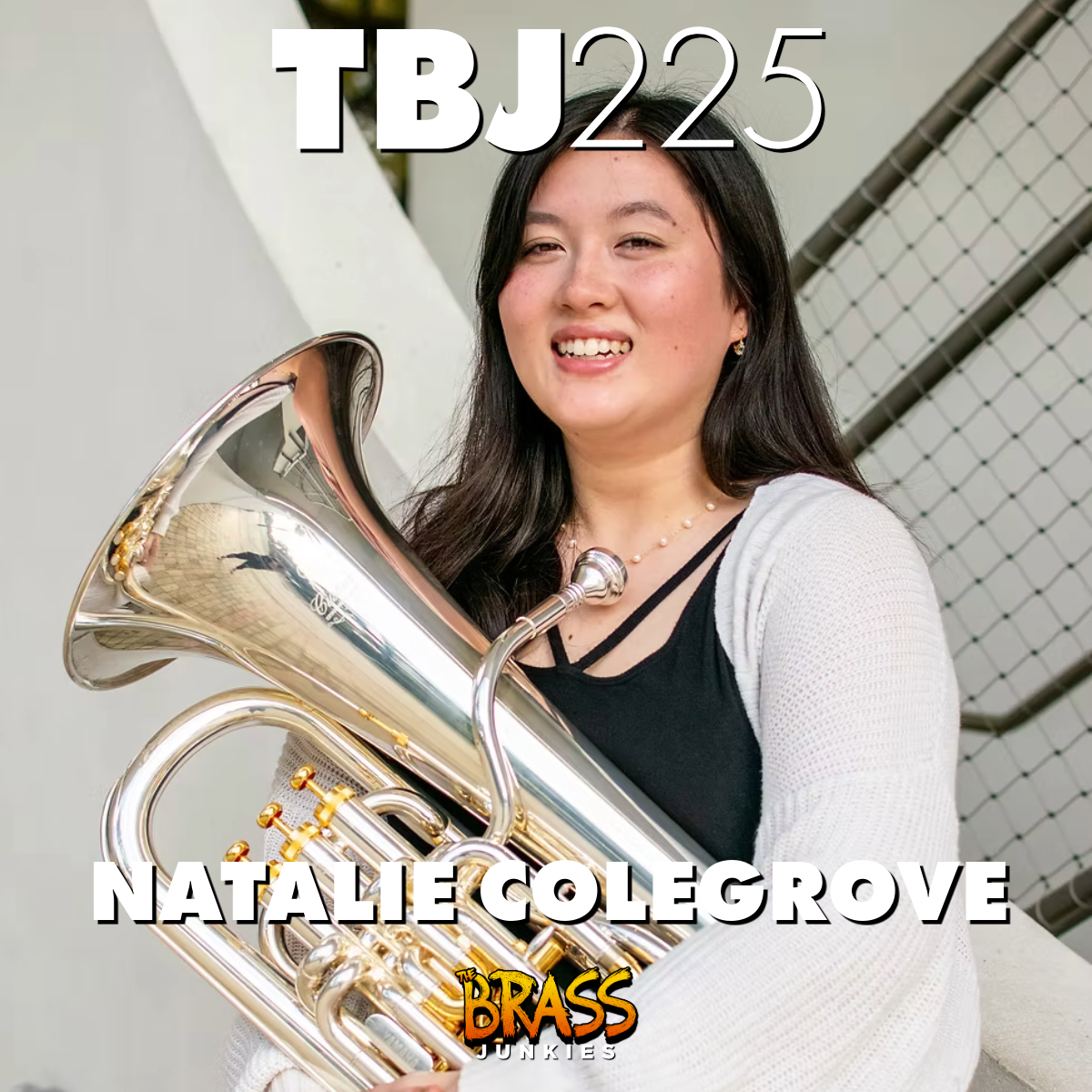
Natalie Colegrove walked out of the Artist Solo Competition at ITEC in Valencia sure she had played her last note on the euphonium, and a few hours later her phone rang with an invitation to solo with The U.S. Army Band. She tells Andrew Hitz and guest co-host Mike Roylance how she spent the next 10 months preparing that performance, including a way of marking her music that only someone who sees every note in color could have invented. She also shares what baking 40 loaves of sourdough a week has in common with getting better at the euphonium.
+
Read the Full TranscriptHide the Transcript
This conversation includes a brief mention of suicide. If you or someone you know is struggling, you can call or text 988 to reach the 988 Suicide & Crisis Lifeline in the US.
Andrew Hitz: And today on The Brass Junkies, we are joined by a euphonium player, a social media mogul (my words, not hers), and just a creative force in the music business, and her name is Natalie Colegrove. Natalie, how are you?
Natalie Colegrove: I'm doing well. How are you?
Andrew Hitz: I'm good. I forgot to say your most important qualification: a former Brass Junkies Patreon patron, which I'm sure is at the very, very top of your bio and your CV.
Natalie Colegrove: Exactly.
Andrew Hitz: And how many Brass Junkies episodes have you listened to or watched, would you estimate, in your lifetime?
Natalie Colegrove: I think it's between 150 and 200.
Andrew Hitz: That's a lot.
Natalie Colegrove: Because, you know, in COVID, so this was 2020, I was 17 and 18. And I had nothing to do basically, and I wanted to be a euphonium player. So I would listen to like three episodes a day while I was playing a phone game or crocheting. So I studied up on everyone.
Andrew Hitz: Wow. That's amazing. Yeah, COVID was so boring that listening to three Brass Junkies episodes a day just seemed like a good idea.
Natalie Colegrove: No, I loved it. My favorite episode was the Sam Pilafian episode, and I listened to that multiple times.
Andrew Hitz: Oh, wow. I've actually not listened to that episode since we did it. Sam passed away relatively soon after that, within a year. And then I was like, "Okay, I can't listen to it. I'm just not ready." And this is funny, it's a little dark funny, but I actually had a moment where I was like, "Okay, I am ready to listen to that episode now." I was driving, so I couldn't do anything about it, and a week later, Lance had his accident. And then I was like, "Well, now I'm not ready to listen to it." So I still haven't listened to it. The universe was like, "Yeah, not yet." But I did listen to an episode recently, and I really enjoyed it. So, yeah, thank you for your support.
So we'll start there. Talk about self-serving. What's something that you learned from the people that we interviewed on The Brass Junkies that helped you on your path? Notice I very specifically said learned from someone we interviewed, not from us knuckleheads.
Natalie Colegrove: No, I learned so much from you guys as well. But I just picked up on a lot of different pedagogical things. I remember from Mike's podcast, I learned so much about audition prep and the schedule and the lead-up to auditions. I took notes during the podcast, and then I used it later on when I took military band auditions, like playing it at 50% and then increasing every week.
Mike Roylance: Wow. Did Andy send you that? Was that a prompt?
Natalie Colegrove: No. This was like six years ago.
Andrew Hitz: I Venmo'd her 20 bucks. I was like, "Mike's been a little down in the dumps lately. Just say something nice about him right out of the gates. That's gonna help the interview go better."
Mike Roylance: Thank you. I'm gonna pay attention now. This is amazing.
Natalie Colegrove: No, I really learned so much about the tuba/euphonium community, kind of the people in it and how to make it, in a way.
Mike Roylance: Yeah. So were you in high school at that time, or your first year of college?
Natalie Colegrove: I was in high school.
Mike Roylance: It was such a strange time, but it was like this podcast, and then, I don't know if you knew, but we had a weekly Zoom call where sometimes we had 20 countries log on, and all these tuba and euphonium players from all over the place would get together and just say hello. And honestly, there's still people that are logging on to that every week, and I get a notification. I can't usually, because I'm at work, but it's fascinating. And there was one guy who had some major health problems, but he insisted on joining every week no matter what. He wasn't in hospice, but he was in full-term hospital care, and he would schedule his therapy sessions around this. And when Roger passed, that was a big loss. But that was Roger, and that's how I really got to know Roger Bobo, was through this podcast. Well, it's actually not this podcast.
Andrew Hitz: The Hang.
Mike Roylance: I mean, everything comes from this podcast. This podcast is where it's at.
Andrew Hitz: So Natalie, COVID hit during your senior year of high school?
Natalie Colegrove: I was in my junior year, in California.
Andrew Hitz: Okay, but it affected senior year as well, obviously.
Natalie Colegrove: Yeah. Because I was in California in 2020, and then my family moved to Texas so I could go to school and finish my senior year, because the California school was closed for, like, three years. But I got to go to school in Texas and play in band. And I actually cried the first time we played together. It was Sleigh Ride, and it was so crazy just playing the same thing with other people around me after not doing that for half a year or something.
Mike Roylance: That's amazing. And COVID really put a dent in band and music education in general. There's a big bump, or hiccup, in music education continuity. Both my older daughters, who were in high school and middle school at the time, stopped completely, because there were only so many times that the online class said, "Okay, why don't you record yourself singing this." Band is a communal thing, as you just said, and it's so important to have that weekly, if not daily, experience. I'm glad we're past that. I'm glad you got to experience Texas music education, because there's nothing like it. It is without a doubt the pinnacle of music education, I think.
Andrew Hitz: I have also cried during Sleigh Ride a lot, but that was just because I was bored.
Mike Roylance: I play Sleigh Ride quite a bit. Interesting.
Andrew Hitz: No, it's funny. The first time that I played a brass quintet gig, it was outdoors, actually right between the Watergate and the Kennedy Center, and there were people at the Watergate who were out on their balconies watching. I remember that was one of the most meaningful concerts of my life, just because I got to do this again. It wasn't some fancy hall, and it wasn't in a foreign country. It was just right down the street. There's nothing quite like making music with other people, and once it was gone, that really came into focus.
So I wanna talk to you about soloing at the Army conference last year.
Natalie Colegrove: Oh, yeah.
Andrew Hitz: How was that?
Natalie Colegrove: That was crazy. Well, it's a crazy story actually, because I got the call from Chris Buckley while I was in Spain, because I was at ITEC in Spain. Okay, let me just start.
Andrew Hitz: Give us the whole thing.
Natalie Colegrove: This was the day of the competition. I was doing the Artist Solo Competition, and I completely flopped. I was prepared, and my mind was right, except 10 minutes before, something was freaking out in me, and I couldn't breathe or something. And then I went in, and I played horribly. So bad. There's no excuse. And then I come out, and I go into a practice room, and I'm crying, like, "I'm gonna quit euphonium. This was my last chance," or something.
Mike Roylance: Oh, that's tough.
Natalie Colegrove: But I was praying about it, and I got peace. Like, "Whatever plan you have for me, God, I trust you. If you want me to quit, then I can quit. If you want me to keep going, I can keep going." And so I stopped crying. And then we had a group of friends that went out to dinner and just looked around Valencia, which was such a gift, because I didn't play the next rounds of the competition, but I got to tour around Valencia. And then that evening at 5:00 PM, Chris Buckley called me and asked me to solo with the Army band. And I was like, "Okay. I'm gonna play euphonium. I'm gonna do this."
Mike Roylance: Wow. What a nice story.
Andrew Hitz: That's amazing. Talk about extremes, all within a few hours, right? Being ready to quit and then Chris calling and saying, "Hey, why don't you solo with us?" I think it's really good for young aspiring musicians to hear that somebody who plays as well as you do had an experience, and you're very generous to share it the way that you just did, that was so poor compared to how prepared you were. Have you done any self-reflection on that? Mike will tell you, as will I, that you can't always play your best. It doesn't matter how prepared you are. It just doesn't work that way. But you said about 10 minutes before, there was something in you that was just not sitting right.
Natalie Colegrove: Yeah. Something in me wasn't sitting right, and I think it was all connected, you know? I took beta blockers, and I don't take beta blockers anymore. But it was the sort of thing where I was depending on myself to play well, but I can't do that, and I can't depend on this drug to help me play well. And so since after the Army conference, I haven't taken beta blockers, and it's been so much better.
Mike Roylance: Interesting. I think it's definitely a great solution for some people, and for some people not. I tried using beta blockers for a bit. Not that we need to go down this road, because we're not doctors. But to me, it wasn't the right fit, so I stopped right away. I tried it while I was prepping for auditions back in the day, and it just didn't feel right.
Natalie Colegrove: Yeah. And I don't feel right lying to the doctor, saying I have performance anxiety, to get these drugs, and so I completely stopped.
Andrew Hitz: That's interesting. I have never taken beta blockers, but I do know some musicians who are wonderful who use them regularly. As Mike just said, even though he likes to call me Dr. Hitz, because he likes to give me an honorary doctorate apparently, I'm not a doctor of any kind. Not of tuba, and I'm certainly not a psychiatrist. But that's really interesting.
So can you talk us through the actual process of the conference? You got that call in the summer, right? So you had, what, eight months or seven months?
Natalie Colegrove: I think it was 10 months.
Andrew Hitz: Okay. And how did you decide what to play?
Natalie Colegrove: Well, I was looking through the things I wanted to play, and there was the Chaminade Flute Concertino, but there would have to be a new arrangement for orchestra in the key that it's arranged in, so I couldn't do that. And then I remembered that I had a clarinet friend, and I went to her recital, and she played the Suite from The Victorian Kitchen Garden. And I was like, "I wanna play that." I listened to it, and I'm like, "This is the piece." Because it's beautiful music, and that's something that I think the euphonium/tuba community struggles with a lot. It's not beautiful. It's technical. It's kinda wonky, you know?
Mike Roylance: Who was the composer?
Natalie Colegrove: Paul Reade. He's a British composer. He did, like, film music.
Andrew Hitz: Let's keep going with this. So you've got all these months to prepare, and then you get to DC, to Virginia technically. When was the rehearsal? Put us there, in your few days leading up to the performance.
Natalie Colegrove: Well, actually, five days before I left for DC, I still didn't have a dress, which is a big deal for people. It was a super big deal for me, because I wanted it to represent me and also the piece I was playing. I had been praying about it for five months at that point, and I was looking everywhere. I was going to thrift stores. I went to Texas to go shopping, and I couldn't find the dress. I went to Nordstrom. I couldn't find the dress, and the only one that they had was like $1,300, which I liked, but it wasn't the dress. And so we had five minutes left, basically, before I had to go somewhere, and we went across the mall to Neiman Marcus, and we were looking around. And then I spotted this blue sleeve tucked in the corner. There was no label on top of it, like Zimmermann or any designer thing, and I was like, "I have to see that." I was drawn to it, and then I found it, and it was the silk light blue Zimmermann dress, which was $800. And it was a great deal, because I was expecting to pay like $1,000 for this dress. So I got it, and then I ordered the right size. I got it two days before I had to leave, and then I went to the conference.
Andrew Hitz: Wow. That's a layer of stress that I've never had to deal with.
Natalie Colegrove: It's a layer of trust and faith that I have to have.
Andrew Hitz: That's great. But I like that you're talking about how the fashion had to match both your voice and the piece. It's very thoughtful. That's awesome. So when did you get to town, and how many rehearsals did you have?
Natalie Colegrove: I got there Monday, and then I had the rehearsal on Tuesday. I think I had a rehearsal every day except the day of the performance, and the performance was on Saturday night. And it was great. I had to push in all the way, because I was so flat compared to the orchestra.
Mike Roylance: Did you memorize it?
Natalie Colegrove: I wanted to, but I didn't. There was so much I had to add in. So many musical decisions added in a month before, kind of perfecting it, so I didn't wanna miss any of those.
Andrew Hitz: Actually, let's rewind. Talk to me about a month beforehand, when you said you were making musical decisions and perfecting it. Was that something where you intentionally went in to make a number of decisions all at once, or is that just where you got with your creative process and it happened organically?
Natalie Colegrove: Yeah, it happened organically, because I worked on it periodically for those 10 months, and as I matured, the piece matured as well. The more I played it, the more I understood the piece, and the more sensitivity I could get out of my playing, you know what I mean?
During that time, I developed a way for me to notate my musicality, because I have synesthesia, which is colors associated with numbers and letters and sounds and people. So I really resonate with colors. And so any time I felt like the music was breathing in, I highlighted it green, and whenever it was breathing out, I highlighted it yellow. But there's even more intricacy than that. I played for Evan, my boyfriend, quite a few times, and we were just working through it. Like, this movement says summer. What does summer mean? It's not just hot, you know? It's blossoms. It's the best time of year. And I had to figure out what I was trying to portray. The movement Mists, I kind of simplified it in the beginning, because I thought mists would be fall. The movements are Spring, Summer, and then Exotica and Mists, and I was like, spring, summer, winter, fall. But that's not at all what it was. Mists was like when you're walking on this path, and it's foggy and misty, and you don't know what's ahead of you, but you still have to keep walking. And I wanted to embody that in the piece.
Mike Roylance: Fascinating. Sounds like what happened after a wedding one night, but we'll go on. So this piece was originally for clarinet and piano, or clarinet and harp?
Natalie Colegrove: Clarinet and harp and orchestra. It's actually from my favorite TV show now.
Mike Roylance: There you go. What's that?
Natalie Colegrove: The Victorian Kitchen Garden.
Mike Roylance: That's the name of the TV show as well?
Natalie Colegrove: Yes. It's this really old British guy who is a master gardener in a Victorian kitchen garden, and every episode is a month. So September, you're harvesting all these squash and cucumbers and things. And he's just talking about how they used to have kittens tied to a rope along the garden so that they would chase away birds, and stuff like that. It's just so fascinating.
Andrew Hitz: Wow, I see this is from 1987, so this is an old show.
Natalie Colegrove: Yes. It's so calm compared to all the shows these days.
Andrew Hitz: That's not a bad thing, right?
Mike Roylance: Well, I don't know. Having kittens tied to a rope doesn't sound very calm.
Natalie Colegrove: It's so cute.
Andrew Hitz: Do you mind if I ask you a little bit more about your synesthesia?
Natalie Colegrove: I don't mind.
Andrew Hitz: I'm fascinated by this, and this is a brand new concept to me. Do you feel like it makes music easier, or more difficult? Is it an asset? Is it a liability? Maybe talk us through that a little bit.
Natalie Colegrove: It's both a blessing and a curse in ways. You know how all the notes have letters? So whenever I look at a sheet of music, every dot is the color of the letter. So if I see an A, it's a red dot. If I see a B flat, it's a purple dot. And so when I would read scales, I would see a bunch of colors, and I would follow the colors, you know? But that makes G major so difficult for me, because it's all brown. I don't know what notes these are. I keep mixing them up. And E flat major, it's also very brown, because E flat, G, D, they're all brown. So I have this overview of music that I can see in color, and I can push and pull what shades I want, but I also have that curse of, I don't know what pitch I'm playing, you know? Because I don't have perfect pitch. I don't have relative pitch. It's kind of just by feel.
Mike Roylance: Well, that was my next question: did this help you develop better relative pitch, or do you have perfect pitch?
Natalie Colegrove: I think that's something I might have to work on. I'll have to practice that. But I don't have any of that right now.
Mike Roylance: It doesn't matter where the E flat is, what octave it's in, it's brown.
Natalie Colegrove: It's brown. And it's a specific shade of brown. It's light brown.
Mike Roylance: All E flats. Okay. And what color is C?
Natalie Colegrove: C's blue.
Mike Roylance: Blue. Interesting.
Andrew Hitz: So do you think of an arpeggio as three colors in a row?
Natalie Colegrove: Yes.
Mike Roylance: Wow. So have you seen Close Encounters?
Natalie Colegrove: Yes, I have.
Mike Roylance: Does that scene with the mothership and the colors have any relevance? Or was that completely contrary to what you were hearing? Or, it's not what you hear, it's what you see. Is that correct?
Natalie Colegrove: I can see what you're saying, because it's the board that they have. But it's more like pops, and it's more like shades in my vision.
Mike Roylance: Interesting.
Andrew Hitz: Wow. I'm drawing a parallel with fixed do. Fa, la, do is an F major arpeggio in fixed do, where the note names don't change according to the scale degree. So your colors are fixed. That's really, really interesting.
And you said that you highlighted when the music was breathing in. Talk about that a little bit more.
Natalie Colegrove: Well, I feel like I sound crazy, but do you understand what I mean?
Andrew Hitz: Yes, I do understand. You're fine. This is fascinating. And I'm totally cutting you off, I asked you a question and I'm not letting you answer, but I'm just gonna say it, even though we were off camera: you were like, "Why did you want to interview me?" Because you're really thoughtful about just about everything. About the dress, about the musical decisions. I bet it sounded just fine a month before the thing, and then you decided to make even more decisions. This is exactly why we're talking to you, because you're very thoughtful about the entire artistic process. So what did you mean by the music breathing in?
Natalie Colegrove: Well, you know when a phrase goes somewhere and then turns and then comes back from somewhere? I would listen to music, and I'd feel myself breathe in, and then relax when it was the release. And so I wanted to notate that, because I couldn't just do, like, a star: "I'm gonna go to here, come back." Because there's so many intricacies. Sometimes it goes and pulls back, and goes and then pulls back, you know? Do you guys have ways of notating that? Or do you just do it by feel?
Mike Roylance: I would say mostly by feel. I'm always trying to get students to come to the BSO concerts and listen, and come with a score and see. There are definitely tendencies of a certain type of phrase or chordal progression. You'll hear the melody grow, and you'll hear it speed up or slow down or get loud or get soft. It's sort of common musical practice to do these types of things. An ascending line generally gets louder. A descending line generally gets softer. It's not always the case, but those are generalities. In truth, there are unwritten musical practice standards out there, and as far as I know, I've never seen any shorthand to really teach that. But that's not a bad idea.
The closest that I can think of is Tabuteau's numbering system. If you're not familiar with Marcel Tabuteau, he was principal oboe in the Philadelphia Orchestra, I think in the '30s and '40s. He was Arnold Jacobs' teacher, and he's basically the grandfather of almost every principal oboe in every orchestra in the United States, if you did a genealogical chart. He has this great numbering system where it doesn't matter if you're having a terrible day or a great day, you're still gonna be able to be a phrase doctor. You're still gonna be able to make great musical phrases, because you understand the power of forward motion in music, and you understand creating forward motion within different rhythmic note groupings. I could go down this rabbit hole for a long time, but I highly encourage you to do a deep rabbit-hole dive on Marcel Tabuteau. I'll stop there, 'cause I'll keep going.
Natalie Colegrove: I would love to.
Andrew Hitz: The one- and two-note phrase thing from him, I learned it from Ray Still, who was in the Chicago Symphony forever, who was a Tabuteau student. Tabuteau was principal oboe of Philly from 1915 to 1954. That is a long run right there. But it is similar to what you're talking about, and I actually teach the one- and two-note phrase thing. I was teaching it to somebody last night. But there's nothing that I write into the music. It's more of an internalized thing.
So, possibly the last question on this, 'cause I could ask you about this for hours. When you highlighted the breathing in of the music, I think you said green. Are there any notes that are green, or did you choose a color that does not also correspond with pitches?
Natalie Colegrove: Well, there are no notes that are green. But it's kind of complicated. I can physically see that the page is black, and it doesn't bother me that there's stuff on top of it, like a highlight. It's just like an overlay. I can see the color is different. It makes sight-reading really easy, though.
Mike Roylance: I bet.
Andrew Hitz: Wow. So your brain just processes so much data in real time.
Natalie Colegrove: Yeah. Too much. I failed in so many spelling bees. I'm still pretty bad at spelling.
Mike Roylance: I bet you'd be a great code breaker. You'd be incredible at breaking codes, for sure.
Natalie Colegrove: Oh, yeah, 'cause I can recognize it instantly. Those Facebook memes, like the S's in fives. I can see it, boom.
Andrew Hitz: This is exactly why I asked whether it was a blessing or a curse, 'cause as soon as you said this I was like, "This sounds like it would be amazing and also challenging." And it turns out that's exactly your experience. Sorry, now the actual... this is like the conductor saying, "Okay, last time," and then doing it again. Actual last question on this. Have you seen these colors all along? And if the answer is yes, when did you first learn that people like Mike and I are not seeing any colors whatsoever, and what was that like when you realized that you were different than just about everybody else?
Natalie Colegrove: So in fifth grade, we were doing multiplication problems. We raised our hand if we found a way to solve the problem, and everyone did it, and I was at the end, and I raised my hand, 'cause nobody was mentioning the colors of the numbers. And I was like, "Well, blue times yellow equals white and purple," right? And then the teacher was like, "What's going on?" And I was like, "Oh, shoot, you guys don't see this stuff?" And my sister has it too, so I was talking with her, but we have different colors from each other, and that's when I started researching it. I'm like, "You guys see things in black? How do you picture it? How do you even read?"
Mike Roylance: That's fascinating. Is it something that's genetic? Obviously it's in your sister, but your family?
Natalie Colegrove: I have no idea. I haven't met anyone in my family that has it. It seems to be genetic.
Mike Roylance: Yeah, I was reading about it right now. It's fascinating.
Andrew Hitz: Mike and I are learning a lot. We also have a lot to learn, so this is a very good coincidence. All right, I just want to wrap up the first half of this with the day of the performance at the Army conference, 'cause most of the people listening to us right now have not had that high-profile of a solo performance. That's basically the very top of our profession. What was that like? Did you try to treat it just like any other performance? If you did, were you successful? Or did you have a different way to approach it?
Natalie Colegrove: Well, I had been preparing my mind the whole time, since the beginning of the 10 months. But that day, it was just so much prayer and reading the Bible, reading the Word, and just giving everything up. Like, this is not my performance. This is God's performance. This is God speaking through me. Let no glory come to me. All the glory to God, because I wouldn't be here if it weren't for God. And so it was just that, giving up and trusting. That was my preparation. And I just relaxed basically the whole day. I took a lot of walks. I ate my ham and cheese with mustard sandwich.
Mike Roylance: That sounds like a nice children's book. I like that.
Natalie Colegrove: That's what I always eat whenever I travel, 'cause my boyfriend makes me a loaf of bread, and then I get somewhere, and I buy some meat and some cheese and some mustard, and then I eat that.
Andrew Hitz: So you fly with your own bread. This is amazing.
Natalie Colegrove: Yes. I'm actually a baker. I have a micro bakery. I make about 40 loaves of sourdough a week.
Mike Roylance: Funny, isn't it? My student Frank John gave me a loaf of bread today.
Natalie Colegrove: Oh my goodness. Is it sourdough?
Mike Roylance: Yeah, it is. I almost forgot to take it out of my backpack, so thanks for letting me know.
Natalie Colegrove: Can I see it? Can I see the crumb? Ooh. Yes.
Mike Roylance: Can you smell it? It's so good.
Andrew Hitz: And today on The Bread Junkies, we are joined by baker Natalie Colegrove. Wow. All right. When we come back, we are gonna ask you about baking bread, 'cause that sounds like something that is right up your alley.
All right. We are back with Natalie Colegrove. Natalie, you just mentioned that you bake bread, and then Mike mysteriously pulled a fresh loaf of bread out of his backpack. I wish I could say that was planned. You were talking, and I was like, "I need to pay attention to Natalie, but what is Mike doing?" I was a little nervous, 'cause he looked very excited. I was like, "What is happening here?"
Mike Roylance: I have a purpose. I finally had a purpose.
Andrew Hitz: It's amazing. So Natalie, did you learn to bake during the pandemic, or was it before then? I only ask 'cause we were already talking about that.
Natalie Colegrove: It was definitely after.
Andrew Hitz: You didn't have time to bake. You were listening to The Brass Junkies five hours a day.
Natalie Colegrove: That's true. Seriously, I was. I wouldn't even practice. I would just listen. But yeah, I started learning how to make bread when I came to college my freshman year. I made my own starter. And it was disgusting, because I made it in this place that had black mold, and I lived there for two years. It was horrible. So I had this starter that had black mold air, and I would bake bread with it. The bread tasted very good, though. But then it got bugs, and so I threw it away.
Andrew Hitz: Wait, why did you throw away the black mold bug starter?
Natalie Colegrove: I couldn't bake with it.
Mike Roylance: You could've started a whole new thing.
Natalie Colegrove: With that air. Well, I gave up on bread. And then I started dating my current boyfriend, Evan, and his mom bakes sourdough. She still bakes sourdough. And so she gave me some of hers dehydrated, and I started again last year, and I've been baking ever since. And now I have a micro bakery at our church, and I bake about 40 loaves a week to sell.
Mike Roylance: Wow. Fantastic. I bet that smells amazing.
Natalie Colegrove: It does. We do add-ins. You know the classic Miami flavor, guava and cheese? Every Cuban bakery has guava cheese pastelitos. I do rosemary garlic. We have a cinnamon raisin with a proprietary cinnamon blend, and then chocolate with a proprietary chocolate blend.
Mike Roylance: Somebody's gonna get my address at the end of this.
Andrew Hitz: I love it. This conversation has escalated. I didn't know that you baked bread, and that's really neat. Have you noticed parallels between your euphonium playing and your bread making, just in terms of not really knowing what you're doing at first, 'cause nobody does, and then progressing? Or have you never thought about that?
Natalie Colegrove: I always think about these things. Yeah, you take off, because you figure something out. I bake on Saturday, pretty much 12 hours, and every week I figure out one breakthrough, and then it stays with me. And then I go to the next week, and there's one breakthrough. And the bread just gets better and better.
Mike Roylance: That's why when you go flying, you wanna fly with an older pilot, just so you know.
Andrew Hitz: They make better bread.
Natalie Colegrove: I used to call myself an underbaked brownie.
Andrew Hitz: I think I'm Barbara Walters: "And how did that make you feel?" We all know exactly what that means, but why did you call yourself that?
Natalie Colegrove: So when I was in college, I was learning how to play the euphonium, and it was like I was being made with a great recipe, with great ingredients. I just wasn't baked long enough. I wasn't old enough to be able to make the music I wanted to make. And so so much of my process has been just maturing and getting older, like baking, 'cause I know I've been created with good ingredients.
Mike Roylance: That took a lot of wisdom to come to that realization, though, right? That's a huge hurdle, to come to the realization that, "Hey, I'm not there yet, but I have it all. I just need to figure out how to get there."
Natalie Colegrove: Yeah. So much patience. And patience as in long-suffering.
Mike Roylance: I started writing a chronicle book on the audition prep stuff that you heard. And at one point, I added up the amount of hours that you put into each audition, and it was something like 1,200 hours for four minutes of glory, 'cause that's really what it comes down to in every audition.
Natalie Colegrove: I would love to read that book.
Mike Roylance: Well, it's on the Google Drive, so it will happen. One of these years I'll get to it. Maybe Andy's gonna help me finish it.
Andrew Hitz: Absolutely. Natalie, he's already asked you for a loaf of bread. You tell him, "No book, no bread."
Natalie Colegrove: Yeah, let's do a trade. I'll go to Boston.
Andrew Hitz: There we go. Look at me building bridges. I'm a real bridge builder.
Natalie Colegrove: I went there this summer to see the Shires factory.
Mike Roylance: Oh, nice.
Andrew Hitz: That's really great. So, a question about patience. Have you always had patience? I guess there have got to be a couple of humans that would say yes, but most of us are like, "No, I didn't have patience when I was seven." When did you start to develop patience? Did it happen organically, or was it something you realized you needed and did intentional things to make happen?
Natalie Colegrove: Well, at the beginning of 2026, I set a theme for the year. Last year was health, and I decided to go to the gym, and I've lost 70 pounds now.
Mike Roylance: Did you say seven zero? Wow, that's amazing. Congratulations.
Natalie Colegrove: You should see my before pictures. But this year, the theme was patience. And so instead of having a New Year's resolution, where you can fall off, patience is an overarching goal, and it's just, am I in line with that goal in every decision that I make? Because I realized so many parts of my life weren't good enough because I didn't have patience. In relationships, I didn't have patience with people when I was talking with them, or with the driver in front of me, and I knew I had to work on that. And it's been worked in me this year so much.
Mike Roylance: That's a very Yoda place to come to at 23 years old. How did you come to that advanced Yoda stage at 23?
Natalie Colegrove: Oh, it's all Jesus. 'Cause he saved my life. I would be dead right now if he weren't here. I actually was gonna end my life, but he saved me.
Mike Roylance: Glad you didn't.
Andrew Hitz: Yes. You've got so much to offer. You are so thoughtful about so many different things. I hope this doesn't sound in any way patronizing, but as a 22-year-old, to have a theme for the year... When I was 22, I was just like, "I'm gonna play the tuba as well as I possibly can and try and earn a living doing it." That was basically it. Not that I didn't do any good in the world, but there was no theme to my year. And I say that from a place of admiration, that you are that thoughtful about stuff. That's pretty darn cool.
Mike Roylance: Yeah. I can see why people entrust you with their social media platforms, 'cause you're so well thought out.
Andrew Hitz: Look at the segue. That's what we were talking about next. I didn't think he had it in him. That was a professional segue, until I talked about how good of a segue it was. So you run social media professionally for a number of organizations. First of all, who are those organizations? And then I wanna talk to you about social media in general.
Natalie Colegrove: I run the social media for about eight organizations or people. My first job was ITEA, the International Tuba Euphonium Association. And then I do it for a nonprofit called Mind&Melody, which brings music to people with Alzheimer's. I worked with Jim Self. I did his social media. I do it for Kenneth Chay, who is a saxophone soloist in Iowa, and a lot of other people. I do it for H&H Music in Indiana, which is a music store. It's all remote work, and it's great for me, so I can always travel and play and do gigs while still doing work and making a living.
Andrew Hitz: That's really smart. So you have multiple social media accounts, some that have tens of thousands of followers...
Natalie Colegrove: 50.
Andrew Hitz: ...and some that you have not posted on very much, if at all, in recent years. Can you talk to us about how your personal relationship with social media has changed? Is it because you do it for a living now? Is it because you've changed your opinion of how it's useful for you? A combination of the two? What changed from you posting all the time?
Natalie Colegrove: It changed because I realized my initial motivation was based on pride. First of all, I didn't want people to underestimate me, because I was a girl at the time, and I didn't want them to gloss over me, 'cause I could play, and I knew I could play, and so I was posting. But then it became a pride thing, like, "I'm better than all of you, so I'm gonna play this, and I hope you enjoy," you know? But now I don't wanna do that. And so when I get to a point where I can record and make music without pride, then I will post again. So I'm on a bit of a hiatus, I guess.
Andrew Hitz: Interesting. And how will you know when you can do that?
Natalie Colegrove: Well, I've been trying. I've been recording myself every week or so, and I listen to it, and I'm like, "This is not good enough." 'Cause I know when it is good enough, and then I will post it.
Andrew Hitz: Wow. That's really interesting. And since you're a professional, what are mistakes that you see people regularly making on social media? There are some obvious ones, like when people post inappropriate things if they're looking to have a professional presence. Other than the really obvious ones, what are some of the mistakes you see people making?
Natalie Colegrove: You know, that's a really good question.
Andrew Hitz: That's one, Mike. I got one good question. And Mike pulled a loaf of bread out of his bag on cue, so he doesn't even have to ask any good questions.
Mike Roylance: Let me give you the next prop.
Natalie Colegrove: Well, I think the biggest thing right now is when people use AI, and it is so obvious, especially to the younger generation, when somebody's using AI. Even a little bit, even just the influence of AI, turns people off immediately. Because in the social media world right now, the trend is trust. When you get on social media, you don't know if you can trust anyone, and so in my social media, I exclusively don't use AI at all. It's all from my head. And you guys grew up without that, but these people, they're growing up with AI.
Mike Roylance: I love the term "these people." It's one of my favorites.
Andrew Hitz: It's true, though. The term "authentic" gets used so much that it almost doesn't mean anything anymore. But I think what you're saying is that anything that you're posting, there is a human behind it, and that human is Natalie, and there's something to be said there. Whereas AI, which is a really powerful tool, everything goes to the middle, right? It's like the bell curve. The interesting stuff's on the sides, and AI by definition, the words, the images, all of it, just goes back to the middle. And so therefore, it's just not that remarkable. It's like somebody who could play the euphonium in tune and in time, but doesn't really have anything to say musically. There's not much breathing in and breathing out of the music, if you will.
Natalie Colegrove: You know what's so interesting about my job is that social media managers usually don't get credit, because these celebrities don't want their audience to know that it's not being run by them. There's nowhere, like on their website or anything, that gives them credit. So I'm actually ghostwriting a lot of these things.
Andrew Hitz: That's interesting.
Mike Roylance: Yeah, I think every celebrity out there does that. If you don't know it, you have to have your head in the sand. But I think what Andy said about AI is right: it's an incredibly powerful tool, and man, has it come on fast. We're talking maybe the last 18 or 24 months, and now it's front and center. 24 months ago it wasn't. And where's it gonna be 10 years from now? I'm curious to get your read. There was a lot of news about AI the last two weeks, about it taking over humanity in 10 years and how we're gonna survive the next 10 years. And some studies said that 70% of the workforce is now using AI in their daily jobs, and the issue is that they're using their own private accounts, so there are no guardrails within each company. So it gets a little bit complicated. So the embracing of the technology as a tool to make life better, how do you see that unfolding? You're right on the front edge of it. I don't sense that you're battling it, but you're definitely right there. What are your thoughts on it?
Natalie Colegrove: I'm definitely biased against AI, because I believe humans have such a valuable mind that no computer can match. And I think there will be a divide: the people who hate AI and don't want to use it, and then the people who love it, and then there's another group in that category that can't live without it. Because I work with someone, and she's required to use AI in her marketing job, because they fired a bunch of people, and now she has to take on the work of three people. And so she uses it so much that she can't really come up with things on her own. The creative part of her brain just doesn't work anymore. And I can't bear to lose that. That would be horrible.
Andrew Hitz: Wow. I always tell my students, and this was taught to me exactly like this, that even if you are good enough at the tuba to do a really good impersonation of Mike Roylance's playing, which is already a pretty small list of people, if we want to hear Mike Roylance, then we're gonna hire Mike Roylance, right? We imitate until we can innovate. I think it was Miles Davis who said it takes a long time to sound like yourself. And I think the human thing is never, like you said, going to go out of style. But it takes a while to get there. If we rely too much on technology for shortcuts, then I think it's actually gonna create a lot of opportunities for the people that don't. And I think your generation is already figuring this out.
Mike Roylance: Yeah, smartly. I love that quote, that it takes a long time to get your own voice out, or figure out what your own voice is. That's one thing that I'm always telling my students, especially nowadays. Back in the day, when I had to walk uphill both ways to get to school, it was hard to find recordings of things. It took a lot of effort, and generally the recordings that you found were the top-shelf recordings, 'cause that's all you had access to. But nowadays, whatever you wanna play, you just type it into YouTube, and there's an example of it. And so I'm always telling people who are learning new pieces to learn the piece completely by themselves, without ever taking a listen to anything else, until you get to the final stage. Maybe then you can embrace other ways of doing it. But at least this way you've learned it through your own voice. Does that make sense?
Andrew Hitz: That's great. If you wanna learn how to speak Spanish, and you were talking about Valencia, if you move to Spain, you're gonna learn how to speak Spanish pretty quickly, right? You're gonna hear the accent. You just have to immerse yourself in things, and be intentional about it. It's incredible how many different ways, just in this conversation, you have talked about how intentional you are, not using those words, about things. It's exactly what the world needs right now. What's next for you? What's your next challenge?
Natalie Colegrove: Challenge? Well, I have a lot of music things coming up, but my life goal is to be a mother. That's the biggest thing for me, to have a lot of children. A lot of godly children. And then everything else is behind that. So music is just my creative output. But I'm touring with Brassology, and I'm going to Missouri, University of Kansas-Missouri.
Mike Roylance: The Jayhawks, right? UMKC?
Natalie Colegrove: I just realized it was in Missouri and not Kansas, so that's a bit crazy. But then I'm going to France in the summer with Brassology.
Andrew Hitz: That's amazing. Before we get emails, which should go to Mike, by the way: UMKC is not the Jayhawks.
Mike Roylance: My email is abair@beartracks.com.
Andrew Hitz: The official mascot of UMKC, I don't know if this is true or not, is a kangaroo named KC Roo. The University of Kansas, in Kansas, those are the Jayhawks, not to be confused with Kansas State. They hate each other, so don't make that mistake. Anyway. So you're playing with Brassology. Tell us about that. How'd you get that gig?
Natalie Colegrove: Well, they found me on Instagram, actually. Apparently they auditioned people on Instagram, and they thought I was the best, and so they messaged me, and then I joined them in Rochester this past ITG.
Andrew Hitz: Wow. That's amazing. And the last thing that I wanted to ask you about, and this was a number of years ago, but you recorded an album during COVID, which is wonderful, and you also recorded some lo-fi tracks. That is not something that the euphonium usually is recording. I believe I read on your website, or maybe it was on your Bandcamp, that you've always enjoyed lo-fi, and at the time it said you listened to it every day. Did you have to kind of give yourself permission to make a lo-fi track on euphonium, since that's not really something that people did? How did you get involved in that?
Natalie Colegrove: Well, I just wanna say I don't do that anymore, and I don't listen to lo-fi anymore. But I've always had so much ambition, and so if I thought about something, then I did it. At that time, there was Lo-Fi Girl, the live stuff on YouTube, and I would listen to that constantly. And I thought, "What if I played something over it?" And then one time, I just started playing a Rochut, I think it's like Rochut 43, over a song that I liked, and it fit together perfectly. It's on my YouTube still. And so I did that. I thought it would be really cool, and I thought it would turn into a big thing. I still have unfinished songs in my DAW, and I don't think I'll ever finish them.
Mike Roylance: That's great. I think you just described yourself, 'cause you are turning into a really big thing. That's really exciting.
Natalie Colegrove: Well, actually, I emailed Lance about the lo-fi stuff, because there was one episode where he was like, "Email me if you have any exciting projects. I wanna listen to it." And so I did email him, and I sent him my lo-fi tracks, and he was like, "Wow, this is amazing. Keep going."
Andrew Hitz: Wow. That's really great. And I also love the fact that you were way into that at the time, and that you decided, "I wanna do this," and you jumped in headfirst, and then that you've moved on. And maybe a year from now you won't be baking bread still, or you might be making bread for the rest of your life. I'm not predicting that you'll move on from that. But there's something really neat about just getting really interested in something, and giving yourself permission to start, and giving yourself permission to stop. That's part of being curious. And I just love that you have so much follow-through. You figure out something, and then you just do it, which is really admirable.
Natalie Colegrove: I think it stems from not being heard as a kid. Because I do have a really soft voice, and in my group of friends, or even with my parents, they couldn't hear me. And so that's why the euphonium was so attractive to me, 'cause I picked it up and it was pretty loud. It was an amplifier for my voice. I could finally express myself, you know? And so it's always been like that. I have an idea, and then I do it. I picked up euphonium, and then my ambition and my pride at that time was like, "I'm gonna be the best." But now it's completely different. My priorities are different. But I'm grateful that I did all that.
Mike Roylance: Do you mind going back in time a little bit, to how you chose the euphonium? How did that come into the picture? You grew up in Cupertino? Is that where you grew up?
Natalie Colegrove: Yes. Cupertino, California, in Silicon Valley.
Mike Roylance: There's another famous low brass player from maybe your same high school, Vivian Kung. Do you know her?
Natalie Colegrove: The same high school, yes.
Mike Roylance: Oh, wow. She lives here in Boston now. She's killing it as well.
Natalie Colegrove: I think she's four or five years older than me, so I never got to see her. But I went to school with her sister.
Mike Roylance: Oh, that's cool. So anyway, back to the genesis of your euphonium years.
Natalie Colegrove: So my dad used to play the trumpet. He played in high school, and then he stopped. And I joined band in middle school because he told me to. And I was like, "I can't play the trumpet. I like this thing called euphonium." It looks really cute. It's small, but not too small, and it's not too big. So I thought it really fit me, and I liked the sound. And I thought, "Nobody plays this, so I can probably get a really good scholarship when I get to college." That's kind of the mindset of Cupertino kids, 'cause they're all prepping for their SATs in middle school.
Andrew Hitz: Jeez. There you go. You are a fascinating human, Natalie.
Natalie Colegrove: I thought you were gonna say creature.
Andrew Hitz: Oh, no. I wasn't gonna go creature. You're just fascinating. I can talk to people who are as passionate about things as you are, even if I am not at all passionate about the same things. And you and I have some overlap in what we're passionate about. But even if it's two totally separate circles on a Venn diagram that are not even barely touching, to hear somebody as thoughtful as you, I can listen to you talk for a long time. So Mike, you got anything else before we wrap here?
Mike Roylance: No, it's been a pleasure. I'm really excited to see what the next 5, 10, 15, 20 years have in store for you. It's really exciting to be around movers and shakers, and you are definitely in that category. So keep doing it. Don't hesitate. I think I'm a product of a mentality where if I got onto a new thing, I just did it, and I maxed it out until it led to something else. It seems like that's what you're doing, so keep it up. Go, go, go you.
Natalie Colegrove: Thank you. It's an honor to meet you both. I've been listening to you guys for a long time.
Andrew Hitz: Well, the honor is ours, and thank you for joining us, Natalie. Natalie's gonna stick around for the bonus episode, which Natalie knows all about, since you are a longtime Patreon patron. That's really neat. Thank you, Mike. Thank you, Natalie. And thank you, everybody, for listening, or watching on the YouTube channel, or wherever you are listening to our voices right now. And that's gonna do it for another episode of The Brass Junkies.