Denise Tryon

Denise Tryon

Professor of Horn at Indiana University and former Fourth Horn of The Philadelphia Orchestra

Appearances

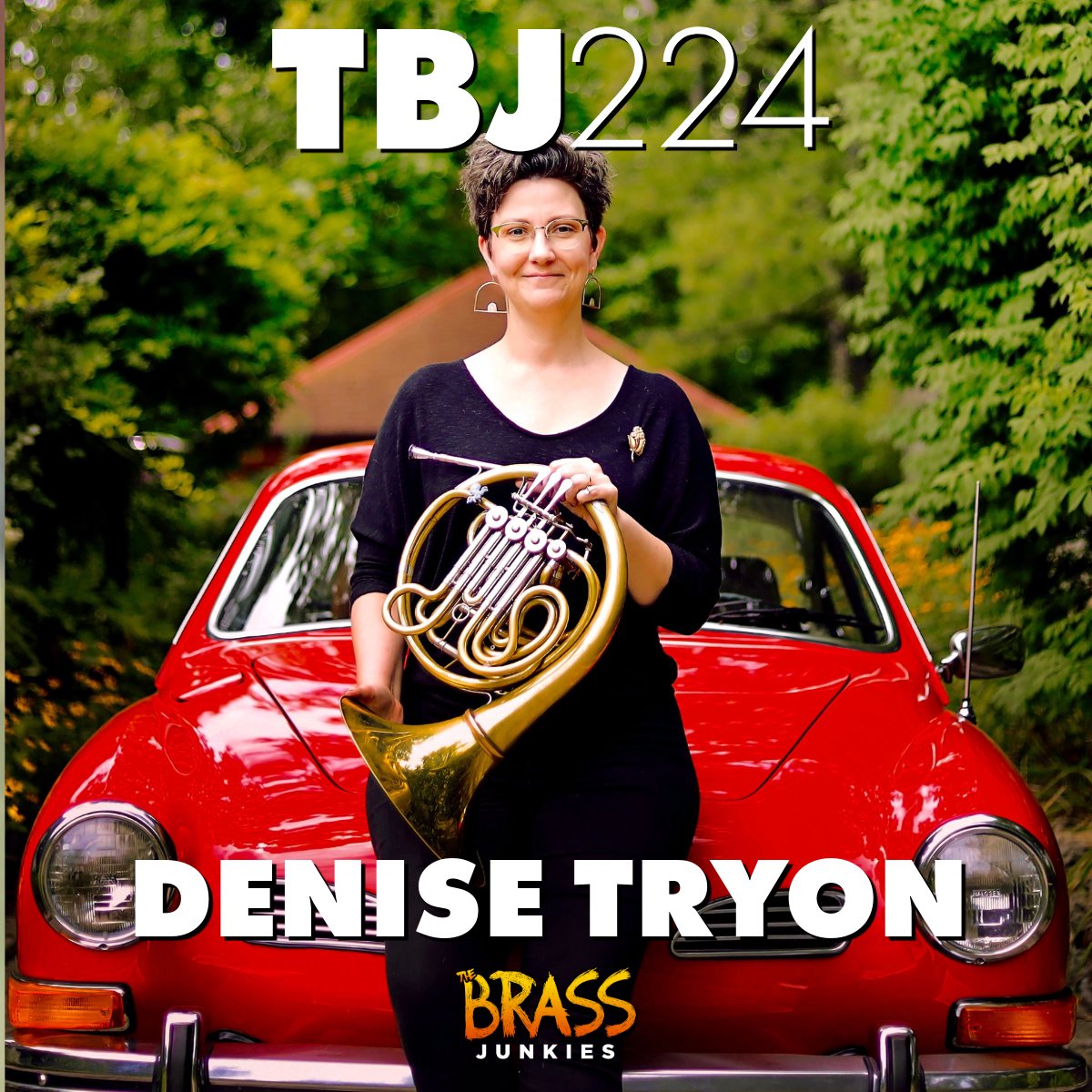
TBJ224: Denise Tryon

Host: Andrew Hitz

Andrew put on Denise Tryon's new recording of the Bach Cello Suites to listen while he worked, and the first movement made him stop and say "wow" out loud. Denise talks about the decision she made at 19 or 20 to record these suites someday, the book she built so horn players make their own choices instead of copying hers, and the first Gavotte of Suite No. 5 that took her close to an hour to get right. She also credits the ice-cold water at a pizza place near the church where she recorded with getting her face through the sessions.

Watch This Episode
Read the Show NotesHide the Show Notes
  • Andrew speaks with hornist Denise Tryon, Professor of Horn at Indiana University and former Fourth Horn of The Philadelphia Orchestra, back on the show nine years after her first appearance
  • In the premiere of Career Corner, presented by Hitz Academy, Andrew speaks with Dr. Julia Bell, Assistant Professor of Trumpet at Texas Tech University and founder of the Magnolia Brass Quintet
  • Andrew's thoughts on the Phoenix Symphony suspending its season and laying off its musicians, and why your support should go directly to the musicians
  • On a scale of nine to 10, exactly how much Denise missed Andrew
  • Her brand new album, Borrowed Bach, featuring Bach Cello Suites 1 through 5 on horn, and the companion book
  • The first movement of the album that made Andrew stop working and say "wow" out loud
  • The childhood piano lessons where she only wanted to play Bach, much to her teacher's chagrin
  • Chuck Kavalovski introducing her to the Wendell Hoss transcription in college
  • The decision she made at 19 or 20 that became a lifelong, "somewhat nagging" project
  • The suggestion that led her to create her own transcription, and how she chose the key for each suite
  • Gail Williams's request that changed how the book is laid out
  • Why Suite No. 6 didn't make the cut
  • How the book is designed to encourage players to make their own choices instead of copying hers
  • Andrew's first lesson at Northwestern with Rex Martin and the two very different Glenn Gould recordings of the Goldberg Variations
  • The dance between technique and musicianship over a career, and the Dietrich Fischer-Dieskau recordings she has her students compare
  • The recording sessions that COVID and a series of setbacks postponed for years, and why she's glad she waited
  • Her approach to the repeats: first time as written, then adding ornamentation the second time
  • The Gavotte from Suite No. 5 that had her wondering what life decisions led her to that moment
  • The advice Sam Pilafian gave Andrew before he produced his first recording session
  • Working with engineer and producer Paul Eachus, a bass trombonist formerly of the Honolulu Symphony, and his rare gift for saying anything without her getting defensive
  • Why her best takes came when she let go, and the instinct to drive with your foot hovering over the brake
  • What she did 15 minutes into that Gavotte to get herself to the finish line
  • The pizza place discovery she credits as her secret sauce for keeping her face fresh
  • Recording in a church in Nashville, Indiana, its tree of life stained glass window, and why they ended up using the microphones closest to her
  • Why Borrowed Bach is the recording she's most proud of
  • The post-project slump her husband sees coming every single time
  • Why all of her students now play out of Bach, and the composer she begged not to write in her every nuance
  • Teaching creative problem solvers instead of teaching to the test
  • Why your job in an audition is to sell people on you, and Andrew's first date analogy
  • The advice from a colleague in her 30s that changed how she thought about her career
  • Being comfortable being different, and making a slower tempo convincing
  • The difference between an earned slowdown to breathe and a convenient one
  • Her train analogy for breathing in fast Bach movements (and the one train stop not to emulate)
  • Breathing as a low horn specialist, and Andrew's recommendation that everyone be 6'4"
  • The next recording project she might already be planning for this summer
  • What Andrew loves most about Denise's approach to music and to life
  • Career Corner: the simple theme that runs through everything Julia has done in her career so far
  • How her goal of an orchestral career evolved during her master's degree
  • What she did once she figured out what a trumpet professor's job actually requires
  • How she started a brass quintet with four women she had never met
  • Why you should apply even when you're sure you won't get the job
  • Andrew's seventh-grade audition for the Junior Massachusetts Youth Wind Ensemble, and why you should never say no for other people
  • Why seasoned players can tell right away when someone is driven and asking the right questions
  • All seven of Andrew's conversations with Julia are coming to The Brass Junkies YouTube channel
Read the Full TranscriptHide the Transcript
Andrew Hitz: Hello, and welcome to the latest episode of The Brass Junkies. I'm your host, Andrew Hitz, and this is about take 17 of this, and I'm just letting it run no matter what happens. So, uh, stay tuned to see if this goes fully sideways. You are about to hear, uh, two different segments. Uh, the first one is, uh, with the, uh, amazing Denise Tryon, professor of horn at Indiana University. Uh, she has just released a new book that features, uh, her transcriptions of the first five Bach Cello Suites, and she talks all about it and how she lays out the book. It's really, really interesting. Um, and, uh, she also, uh, released a stunningly great recording, uh, of all five of them, of her playing them and, um, it's, it's really special. I think you're gonna really enjoy that. We talk about the recording process, um, about her, you know, realizing a lifelong dream of wanting to record these pieces. Um, it, it was a, a wonderful conversation. And then the second segment is with the incredible Dr. Julia Bell, uh, assistant professor of trumpet at Texas Tech University. Um, I will talk about this, uh, right after the Denise episode, but we are debuting, uh, a new segment, uh, that's gonna be an ongoing one here. So, uh, stay tuned, uh, for that, a brief conversation after the main interview with Denise Tryon. Very quickly, before we get to, uh, the episode, I wanted to, uh, share some thoughts on the Phoenix Symphony situation. Uh, just a couple of days ago, uh, management, uh, and the board there, um, notified the musicians that, um, in two weeks is their last concert for the season, and that they are all being laid off and that the season is being canceled. And, um, that is just absolutely heartbreaking. Phoenix is the fifth largest city in the United States. Uh, it is absolute negligence by the board, um, and just incompetence by their, um, y- by their staff, um, and their leadership. Uh, it's just ch- there's no scenario where the musicians should be hearing In mid-October that they are not going to be getting any paychecks after the very beginning of November. Uh, and so, uh, I would encourage everyone, uh, to go to the Phoenix Symphony Musicians Facebook page. They also have a website. I will put the link to both of those in the show notes. Uh, show them support. Uh, I'm guessing that there's going to be some kind of a GoFundMe. It's just infuriating that that needs to- that we live in a world... I'm trying not to curse, so I don't have to mark this one as explicit. Um, anyway, uh, I would, uh, encourage you not to go to Phoenix Symphony's website and hit donate there. Uh, obviously, the institution needs financial support long term to be viable and to employ all these amazing musicians. But for right now, uh, the musicians who have had their worlds rocked are where that money needs to go, if you have any to spare, and, uh, that would not go to them. So, uh, stay tuned, uh, for, um... And I'll, I'll try to announce it here as well, uh, moving forward whenever they announce where that is going to go. Uh, it's an absolute mess. There are five couples in that orchestra, um, who, uh, both partners, uh, play for the symphony who suddenly have absolutely zero income, and that includes their phenomenal tuba player, Christina Cutts, and her, uh, husband, who is the new principal trumpet. Uh, it's just heartbreaking all around. So, um, yeah, you all are in my thoughts, and I, I hope for, uh, for better news, uh, sooner than maybe it appears like it might be coming. In case you missed last week's episode, uh, was with Gail Williams. Um, it was just, oh, she's so special. Nicole Cash was the, the guest co-host. Both of them are people who I just leave in a better mood anytime I talk to them briefly, at length, about trivial things or important things. You can find, uh, clips from that, the transcript, show notes, everything at brassjunkies.com/gailwilliams. And, uh, speaking of which, Denise's artist page, uh, is gonna feature her first appearance on The Brass Junkies. That's brassjunkies.com/denisetryon, and, um, also the show notes for this and, um, and other resources, including the links to, uh, to her new book and to her amazing recording, which you can buy or find on YouTube. Lastly, thank you to Parker Mouthpieces for providing the hosting for The Brass Junkies. Parker Mouthpieces offers fine customizable component mouthpieces for horn, trombone, euphonium, and tuba, including the Andrew Hitz Artist Model tuba mouthpiece and the Lance LaDuke Model euphonium mouthpiece. You can find out more at parkermouthpieces.com. Without further ado, let us get to the conversation that I had with hornist Denise Tryon. Andrew Hitz: And today on The Brass Junkies, I am joined by a guest who last appeared on this podcast nine years ago. Can you believe it? Denise Tryon, how are you? Denise Tryon: I'm good. How are you? Andrew Hitz: I'm good. On a scale of nine to 10, how much did you miss me? Denise Tryon: Hmm, can I say minus two? Andrew Hitz: That's a little rude, but you're- ... uh, I appreciate the honesty. Denise Tryon: Well, we'll just- I thought we'd start, like, hot, hot here. Let's, let's go right at it. Andrew Hitz: So you just released a brand-new book, uh, and a brand-new recording. Um, and I wanted to, uh, to talk about this recording, because I saw the post about the book and I sent you, uh, a message today, an email that said, "If you'd like to be on the podcast and talk about this," um, you know, I'm sure that the book is great. I hadn't seen it, of course, 'cause it just came out. Right. Uh, and you said, yes, and then you said, "Oh, and by the way, there's also a recording and here's a link to it." And this is a true story. It's gonna sound like Denise paid me to say this. Um, but, uh, but yeah, this is, this is a true story- ... that I, uh, you know, I put it on, I hit play, 'cause I was doing work, and I actually... It was good enough that I stopped doing work. This is the, just the very, very first, you know, the first movement of the first, uh, suite. And then after, like, the release of the last note of that, I actually said wow out loud like a crazy person- ... in my, in my office. So, um- Denise Tryon: Well, thank you ... Andrew Hitz: just exquisite. It's really, really, really wonderful. Um, it's wonderful playing and artistry and just, it's, uh... The world does not need any more recordings of the Bach Cello Suites, except when someone has that much to say, and then we need- Thank you every single person who has that much to say to record them themselves. So, Denise Tryon: yeah. Uh, okay. Now, now I'm up to about, like, a, a 9.5. So that was good. I Andrew Hitz: should've ... I really m- that was an own goal. I should've asked you- Yeah, yeah ... after that, uh- ... after that intro. It would've been a different answer. I just went up 11 and a half points- Yeah, exactly on a, on a two-point scale. Well, Denise Tryon: that is, that is some good math right there. Nice Andrew Hitz: job. So thank you. Thank you. Yes. I went to Northwestern, which means I'm smart. But wait, I majored in tuba- Tuba ... which means that I... No, it has nothing to do with my intelligence- No ... me getting in there. Yeah. Uh, so anyway, um, talk to me about, uh, this project. How did it come about? Denise Tryon: Okay. So I've had a, a, a long love of Bach in my life. Um, I actually started... I, I took piano for 10 or 11 years when I was a small kid, and for the last maybe two or three years that I took those piano lessons, I only wanted to play Bach. I don't remember how I heard it, but I just became really enamored with it, uh, much to my teacher's chagrin. Like, she was just like, "Could we play anything else? Chopin?" Sure. "No." So, and then I go to, I go to college and, uh, Chuck Kavalovski introduces me to- There's a, a pretty famous transcription, uh, by Wendell Hoss, and I worked out of that every, every week. And at some point, I don't know, I was 19 or 20, I made the decision that, uh, I wanted to record these. Now, of course, at that point in my life, I had no idea what that meant. Andrew Hitz: Right. Denise Tryon: And I, I just didn't, I didn't know what I was sort of setting up in my brain to be a, a lifelong, uh, hmm, somewhat nagging project. Andrew Hitz: Hmm. Denise Tryon: Um, and so as I was starting to think about wanting, you know, recording these, I was talking to a few people and they're like, "Well, are you gonna do the, the Wendell Hoss edition? Are you gonna do it in the original key?" And I said, "You know, for me, the original key feels a bit low. Um, a- and to me it's like I have a harder time doing some of the musical things I want, and I'm not a huge fan of the Wendell Hoss key at times." And so they said, "Well, why don't you do your own transcription?" And it had never occurred to me to do that until somebody said, suggested it. So I started looking at what key I would like things in, and in the end, keys two and five are still in the same key as the Wendell Hoss. Um, there are some mistakes in the Wendell Hoss, and so, uh, the end of the The second suite prelude is he just, uh, he adds a bunch of arpeggiation in there. Um, so yeah, so I went back to the original. And then I just decided to put two, three, and four in keys that felt a bit h- uh, nicer for my face. Um, I get this wrong every time, but it's like... So let's see. The first suite is up a minor third, I hope I'm doing this right, a minor third from the original. Who knows? Uh, suite f- three is also up a minor third, and suite four is up a whole step from the, from the cello key. I think I have that right. Andrew Hitz: Okay. Denise Tryon: Um, and, uh, so then I was going to put out, um... I thought, well, it'd be great to put out, you know, this transcription in a, in these different keys, and I was just gonna put it out sort of like a Bärenreiter part. No markings, all, all, all the notes, everything that's there. And actually Gail Williams is like, "But I wanna know what you do." So I was like, "Okay." So the first half of the book are the articulations I use and where I choose to take breaths, also what notes I leave in, which obviously I don't leave in all of the notes, um, that the, that the cellos play. And then the back of the book is sort of that Bärenreiter where there's no articulation whatsoever, and every note is listed so then people can decide- Andrew Hitz: Hmm ... Denise Tryon: what do they wanna do, what notes would they prefer to leave in over the ones I left in. Um, so that's, that's where that, that came from. That's how that book came about. But- Love it ... and I did suites one through five because six Um, six is not written for a four-string instrument. It's written for a five-string instrument, and it's not really playable the majority of the time with one voice. So it's one of those things that I would have to sort of, like, either have somebody come play it with me, or I would have to, like, you know, overdub. Right. Uh, and I was not interested in that. So- Right ... um, yeah, I cho- I just chose to do one through five, which is already two hours and 10 minutes of playtime. It's enough. It's enough of me, so. Andrew Hitz: That's a lot. Yeah. Um, I love the setup of the book, that, uh, that you give what you do, and then you give all of it to encourage, explicitly encourage people to figure out what they do. That's, that's really empowering. That's awesome. Denise Tryon: Yeah, I, um... And that's what I wanted when I was just going to do just the only that part. I, I want... Don't be tied down by what I, by wh- what I do. Feel free to choose what you wanna do, because your version might be better, and it's definitely gonna be better suited to you, who's deciding to do this, so. Andrew Hitz: Yeah. Denise Tryon: Um, sometimes I feel like, especially in something like Bach, it's not written for our instrument. We get a little bit tied to what- whoever has done the transcription, what they've put, where those slurs are, where you're supposed to breathe, all of that, and it's like, boy, that, that doesn't feel right to me. So decide what you wanna do. Andrew Hitz: Oh, I love it. Yeah, that's, that's great. Yeah, I, when you were talking about your, your, uh, obsession, my word, uh, with Bach, uh, when you were young, I'm reminded that, uh, in my first lesson ever at Northwestern with Rex Martin, that he told me to get the 1955 recording w- of the Goldberg Variations with Glenn Gould and the 1981 recording, um, and to listen to them, you know, like back to back, and to compare- Mm-hmm just the tempos and the weights and the, you know, like, uh, aggression or lack thereof, and it's just, it was, it was fascinating, and I love both- Yeah ... of them for... And they're so different. It's amazing that it's the same- Yeah ... person. But, um, there's just, there's a lot that you can say with, with Bach. A lot. Yeah. Denise Tryon: For sure. Andrew Hitz: Yeah. Denise Tryon: Well, and I think it's interesting when, when an artist records something, you know, multiple times through their careers, because I sorta feel like, you know, when we're younger, the, the instrument, you know, what we can do on the instrument is almost limitless. Right. It's just about can your imagination do it? And then, of course- Right ... you become a better musician as you age, but maybe at a certain point the technique takes a little bit of a dip. Andrew Hitz: Yeah. Denise Tryon: Um, and, and then obviously as we get a lot older, then, you know, you're an incredible musician, but maybe the instrument is not able to do what you want to do, what you wanna say anymore. So- Yeah ... I tried to pick what... I, I was trying to wait as long as possible, so I hope that I haven't, uh, waited too long in the technique department. But- I, I wanted to talk- Andrew Hitz: But waited long enough for the music ... I wanted to talk to you. That was my next question, was- Yeah, Denise Tryon: yeah, Andrew Hitz: yeah ... do you wish you'd recorded this five years ago? Denise Tryon: Well, funnily, I, I did actually. We had three or four recording sessions set up, uh, uh, years ago, but, like COVID shut it down. Wow. And then my recording engineer, uh, his wife got hurt, and so it was like, he was like, "I can't leave right now." So there, it actually has been planned for- Wow ... off and on for a number of years. Wow. But I'm, I'm glad I waited. Andrew Hitz: Well, I, I want to, for the, I want the record to state, first of all, I know Denise has an amazing sense of humor, and also I s- I said all that really ama- like, I literally said wow out loud. So I feel like I have clearance to make that joke. So- Yeah ... um, yeah, somebody'll, somebody's gonna email me and be mad. Yeah. But, uh, that, that's okay. Um, no, I, what, what you just laid out is like, it's all a, it's this dance in terms of our musicality and our- Mm-hmm ... abilities and, like, and our perspective, and just all of the different ratios there. And none is better than the other, but they're all different. Denise Tryon: Yeah. Like, yeah. Andrew Hitz: Really. Denise Tryon: Yeah, I have, uh, I love listening to Schubert lieder, uh, with, uh, Dietrich Fischer-Dieskau, uh, singing. Mm. And there are, there's a recording of him, I, I don't know the years, but he's definitely on the younger side. I would say probably, like, you know, late 20s, early 30s. Um, and then, and then there's another one when he's in sort of his 40s, maybe up to 50, and I think, I found it once, I haven't found it again, there's one when he's much older. And you can hear all of these things happening, and I can, I can tell that the early recording is incredible, but it doesn't move me. Andrew Hitz: Mm. Denise Tryon: And the middle recording is incredible and it moves me. Andrew Hitz: Mm. Denise Tryon: Uh, and that's a really important distinction for me, and I, I make my students listen to that kind of stuff a lot, so. Andrew Hitz: Oh, that's, uh, yeah, that, that's, that's really great. Denise Tryon: This is what the book looks like. So it's very similar to the front, and originally they had me, had me here, and I was like, "This is not about me at this point." So, um, so there's that. And, uh, you know, going back in, you know, in you can see that there are all the articulations and everything with breath marks. And then I'm, I'm definitely not gonna hit the same... Whoops, I'm still in the part where I'm playing. There we go. And then here you can see where there are no, no articulations and everything's listed as, like, a pure chord, where back in my, the front of the book, it's listed as grace notes. Andrew Hitz: Okay. Denise Tryon: Um, when I was, when I was playing it, I made the decision that, uh, at first I do all the repeats, so buckle up. Um, and then second is on the first time of each section, I chose to play it with as little ornamentation as possible so that we're listening to- just what is the tune. Andrew Hitz: Mm-hmm. Denise Tryon: Um, and then I go back and I add as much or as little as I sort of feel I want to, uh, of ornamentation, be it trills or grace notes or, you know, whatever that is. And, uh, the one time when I really wondered what life decisions led me to this possible choice- ... was the Gavotte- ... the first Gavotte. I think that's right. I'm gonna go with that. The first Gavotte of Suite Five. Andrew Hitz: Okay. Denise Tryon: And, you know, getting the first time was, like, the first time of each section was like, I don't know, eight minutes and I had it done. Andrew Hitz: Right. Denise Tryon: And the second part of each one with the grace notes, I- might have taken me close to an hour. Andrew Hitz: Oof. Denise Tryon: That's Andrew Hitz: a lot of playing. Denise Tryon: I was like, "Oh my God. I did it. I'm done. Ah." So- ... yeah. I really, like, about fif- mi- 15 minutes in I was like, "Why? Why did I choose this?" Andrew Hitz: So- That's, uh, the, um, when I produced my first recording session, uh, beforehand I, uh, did what of course I did, which was, uh, to, um, text Sam Pilafian and, um, and when, uh, he... I said, "What do I do, uh, when I am, uh, producing?" And, uh, he said, um, he said, "I'll call you in five minutes." And, uh, and then he, of course, uh, did call me back, um, in, uh, five minutes. Um, and so Sam called and he was like, "Do you have a pen, pen and paper?" I said, "Of course I do." And he then, like, rattled off, um, like exactly what I needed to do. And, um, and there's actually, I'll put- throw it in the show notes, there's a TEM episode, Entrepreneur Musician episode, where I talk about everything that he shared with me 'cause I took notes. Anyway, the reason I'm bringing this up is because he reminded me that the, you know, that, that one of my main jobs as the producer was managing the humans in front of me. And so, um, can you talk a little bit about, um, what it was like to be, um, to, to be 15 minutes in and to say, like, "Oh no, is this gonna work out?" Denise Tryon: I, I'm not sure if... Yeah, there you are. So sometimes you're freezing. I'm not sure it's you or me, but just in case. Um, yeah, so it's, it's a conversation I had with my, my engineer, producer, Paul Eachus, um, who I've done a number of my CDs with. Um, and he is a bass trombonist, um, you know, played in the Honolulu Symphony, and then got more and more into doing recording and conducting, and things like that. Um, and what I love about working with him is he's able to say anything to me, and I don't take it, I don't get, get defensive about it- That's great ... which is an art, for sure. Right. Um, not me, not me not getting defensive, him saying it in such a way. Andrew Hitz: Yeah. Denise Tryon: And- It is ... um, yeah. So, so, you know, when we were talking about it, he said, "I think that, I think it's a great idea." Like start off with just kind of the simple and add. And, and as I was doing it, he was like, "Okay, we're, you're getting there. Now it's just, like, we need to, like, we have all the bits and pieces. Now I just want you to play it and, like, let go." Andrew Hitz: Mm-hmm. Denise Tryon: You know, just like... And it, honestly, that, those were almost always the best takes- Andrew Hitz: Yes Denise Tryon: when I just let it go and let it fly, and didn't have that worry about this intonation or this rhythm, or something like that. Andrew Hitz: Yeah. Denise Tryon: Um, but sometimes you have to go through all the little details before then you can realize, okay, I can actually just let this go. Um- Andrew Hitz: Isn't it fascinating- So it was- ... even... Oh, I'm sorry. Uh, even with lots of- No, no. Please ... experience making recordings, uh, as both of us have, uh, even though I know not to do this, the instinct can still be to almost be driving with both feet, where you're just like, you're not using the brake, but your foot's right over it when you just- Yeah ... need to just drive. Like just- Denise Tryon: Yeah ... Andrew Hitz: just go. Yeah. Denise Tryon: Just go. Yeah. And, and, and I think that I have moments, you know, where it's just like I can just let it go, and, like, no foot on the brake. I'm just going and having a good time. And then you might have to go back and make sure a certain intonation is X, Y, and Z. But, but in something like that, the repeats of that particular gavotte, and it's really supposed to be a three-part, you know, chord every time you get to it. And I was like, "There's no way I can do that," so I picked one of the other notes. Sometimes it was the lower, sometimes it was the middle. Mm-hmm. Um, and to get where it's consecutive, like, quarters, over and over again, to get that sounding- like I wanted it to musically was very challenging for me. Um, it, it definitely pushed my limits, um- Mm-hmm physically, but also mentally. Like, can I do this? Andrew Hitz: Right. Denise Tryon: Um, so yeah. Andrew Hitz: Yeah. We had, um, we had a little, a little connection issue, so I'll ask- Yeah ... this part of the question again. Yeah. When you, you said you were 15 minutes in, uh, and you were like, you know, like- Yeah ... "Uh-oh." Again, putting words in your mouth. But like- Yeah ... what, what, what did you do mentally to be able to, I'm, I was gonna say pull out of it. It's, you weren't nosediving, but you're just- Yeah, yeah ... like thinking about things too much. What did you do in that moment to enable you to get to the 60-minute mark where everything was nailed? Denise Tryon: Yeah. So, so the, the first thing I had to do was I had to walk away from the horn. Mm-hmm. No doubt about it. I was like, I just give me a five-minute break, and I- Yes ... went and walked and did a bunch of stretching and like looked outside. I was in a beautiful church in the middle of nowhere. And- Mm-hmm ... like, you know, looked outside and was just like, "Okay, time to, you know, put on your big girl pants and go do this." Right. And, and it was just pure like grit. Like I w- I can do this, I just have to figure out how to take all of these turns. Mm-hmm. Um, so yeah, it was, it was more about getting my head into the right place, 'cause if I can get that in the right place then the body will, will follow. I just have to figure out how to get this to, you know, trick in. And a lotta times for me it's I need to walk away from the instrument, for sure. Um- Yeah ... so. Andrew Hitz: Yeah. That's, uh, sometimes it's for chop reasons, and other times it's like purely mental, and then sometimes it's a combination. But- Yeah ... yeah, it's, it's amazing what a little sunshine, um, or eating a banana or a- Yeah yeah, drink of water or whatever. And that goes for, for young people making audition, uh, tapes, uh, as well. See, I'm, I'm old, I just called it a tape. Denise Tryon: That's okay, I say tape all the time, whatever. It's the same generation, we got this. Andrew Hitz: When you- Um- When you pull your reel-to-reel into the practice room- ... with you, yes. Denise Tryon: Here's my eight-track. Um- I, yeah, there was, so I had two different weeks where I recorded this, and I, um, one week was spring break, I guess it's about a year and a half ago now, spring break from school. And then the other one was, like I think it was out of school for two weeks, and then another, and then another week. And I had budgeted a day and a half of recording for each suite. And I'm somebody that I do, any time I record, I do roughly, like, maybe five hours in the day. So I do, like, two and a half hours, and then I usually take hour and a half or two hours of lunch, and then I come back and do another two and a half or a- as long as I can last. That might be two hours, but... And so that first day, we started with suite one. It's the one I've performed the most in my life, so I was like, "This is gonna feel really comfortable to me." And we got it done in that first day, and I was like, "Oh, well, I just bought myself some time. That's awesome." Andrew Hitz: Yes. That's a great feeling. Denise Tryon: That's a great feeling. Yeah. And then day two, I got all of suite two done, and I was like, "Whoo, I'm on a roll." Also, my face is shredded. So we took Wednesday off. Andrew Hitz: Okay. Denise Tryon: Thursday, I came back and went to five, 'cause that's the next one I feel the most comfortable with. But what I discovered, and I really feel like this was the trick, and this is gonna sound so stupid. There was a little pizza place that was nearby, and we went there for lunch. And you know the soda machines where you can go up and refill your own sodas? Mm-hmm. And always in one of them, there's a little button you can press, it'll just give you water. Andrew Hitz: Mm-hmm. Denise Tryon: And so I had my, you know, my water bottle, and I filled it up with that, and we went in and I was drinking out of it, and it was, like, the coldest water without ice. Not artificially cold, it was just really cold. Andrew Hitz: Hmm. Denise Tryon: And I really feel like that kept the swelling in my face down. Okay. So after that, that third day of recording, I said to Paul, I was like, "I'm sorry, we have to go there for lunch every day now 'cause I need that water." Andrew Hitz: I love it. Denise Tryon: Yeah. It's the secret sauce on that one. Andrew Hitz: That's, uh, that's incredible. Uh, that reminds me that, uh, that the, uh, the, the marketing people behind Coors Light have convinced the world that, uh, that beer that is, that when their beer is in the same fridge as other beers, it is somehow colder than the other beers- ... which is, like... Denise Tryon: And then those, is that the one that the, the blue mountain- Andrew Hitz: Yes shows Denise Tryon: up when it's... There you go. Andrew Hitz: Their whole their whole thing- Now it's the right Denise Tryon: temperature ... Andrew Hitz: is that it's cold, and it, because it's from mountains. And it's like, well... But it, I'm, I'm guessing it works or they- Yeah ... wouldn't keep, uh, talking about how- Wouldn't keep doing it ... cold their beer is. But, uh, yeah. It's Denise Tryon: brought to you by ice cold water. Andrew Hitz: Right. Denise Tryon: Yeah. Andrew Hitz: Where did you do the recording? Denise Tryon: Good time. Um, there's a church in Nashville, Indiana, which is about 30-ish minutes from Bloomington. Andrew Hitz: Okay. Denise Tryon: Uh, and it's, it's beautiful in there, and has incredible acoustics. The Chicago Symphony does a little chamber series- Andrew Hitz: Hmm Denise Tryon: in August. Mid-August, late August, something in that church. Andrew Hitz: Okay. Denise Tryon: Um, yeah, beautiful acoustics, and it had this really beautiful tree of life, um, stained glass window that I just- Wow ... kind of fell in love with. Andrew Hitz: Wow. Denise Tryon: And so you can... We actually used... We had a, a, I don't know, maybe eight or 12 microphones going, but we ended up using the ones that were, like, the closest to me because the acoustic was so, um, boomy's not the word I want. I don't know. It had a lot of reverb. Andrew Hitz: Okay. Denise Tryon: Uh, so we end, ended up needing a little bit more of me and a little less of the room, so we ended up using the ones that were kind of the closest to me. Oh, that's great. But, um, it was quiet. Once in a while we'd hear a car going by, but otherwise it was really quiet. Um, and, uh, yeah, I actually think in a couple of the takes you can hear birds, I, I think. Andrew Hitz: Hmm. Denise Tryon: One of my dogs has just walked in. Andrew Hitz: That's- And- Denise Tryon: Yeah. Andrew Hitz: I love how dogs love us unconditionally, but also are not impressed by how good your- No, nothing at all ... Bach Cello Suites recording is. So they just- No ... they just don't know. Denise Tryon: It's like, "Please just stop practicing. Make it Andrew Hitz: stop." So, uh, I have to ask, what does it feel like, uh, to have, like, this, like, lifelong, I don't remember the word you used, but, you know- Yeah this, this vision nagging at you, and you did it. Like, you- Yeah ... you did it. You shipped it. You shared it with the world. It's here. Like, how good does that feel? Denise Tryon: Uh, it feels really great. Awesome. Uh, I mean, I, I, I can't imagine... Well, I guess if I wasn't happy with the recording, I guess it could not feel that way. Andrew Hitz: Right. Denise Tryon: Um, but it's probably the recording I'm the most proud of. Andrew Hitz: Mm. Denise Tryon: Because I know how much, how much work went into it, how many years of just, like, dedication and, and just sort of working at these, at these suites to try and find out who I was as a musician. Andrew Hitz: Mm. Denise Tryon: And so that then I could try and say what I wanted to say in the, in the pieces. Um- Wow ... so for me, it's, it just feels great. And also, every time I finish some big, huge project, I like... So the day after, so this came out on the 9th. Uh, I finally, the delay in the physical book was, uh, you know, it just, I just got to it, uh, two days ago. Mm-hmm. But the, um, the recording came out on the 9th. That was a Friday. On the 11th, I'm sitting on the couch going, "What am I doing with my life? I don't, I don't know. I don't know what to do now." And my husband is like, "Every time, every time you finish a project, you're like, 'What am I doing? What's going on?'" So I'm trying to enjoy a little bit of nothing. Andrew Hitz: Right. Denise Tryon: Um, because it's been months and months of editing and all, all of that stuff. So- Yeah ... it feels really good. Um, and, uh, yeah. So it's just, it's nice to... Well, now he just wants to be in the screen, so. Andrew Hitz: That's, that's great. That's awesome. I love, uh, I also love that your, your definition of doing nothing is, like, you know, full, full professor at- Denise Tryon: Oh, yeah, Andrew Hitz: yeah, yeah Indiana University. And you're pr- you're performing plenty, and you're like- Denise Tryon: Yeah, yeah ... Andrew Hitz: you have a partner. You have a dog. It's like, yeah- Yeah ... your nothing is, is quite a lot. Denise Tryon: Yeah. It's something about that having a full day of I don't have to do any work, and that's, that was, uh, you know, I'm, I'm not great on that work/life balance thing. So- Andrew Hitz: Right ... Denise Tryon: it is, whenever I have one of those days, it is a little bit of a struggle. So I'm- Yeah ... trying to embrace the- Nothingness of my downtime. I'm still working quite hard as a professor and, and horn player, but Andrew Hitz: Well, I think I speak for everybody that I can't wait to see whatever your next project is. But if it's, if it's a goal of yours to not have that start soon, then I hope that, uh... I hope you let it breathe. So yeah, Denise Tryon: we- Thank you. I'm, I'm gonna work on letting it breathe. Also, I don't know, there... I am considering another recording project this summer, so we'll, we'll see. We'll see what happens. Andrew Hitz: That's, uh- Um, Denise Tryon: see if I Andrew Hitz: go that's great. I, I love when people like you talk about chilling out, and then you describe it and you're like, "Oh, boy." Like That's Denise Tryon: not chilling out Andrew Hitz: to me. Maybe I need to- You need to learn something ... maybe I need to, to, like, be like Denise when she chills out. No, no. Yeah, and suddenly I'm- Denise Tryon: No, no, no, Andrew Hitz: no. No? No. Denise Tryon: But no, everyone needs to do their own thing. Andrew Hitz: Um- Of course. Denise Tryon: You know? Yeah. So you gotta- Yeah ... find what's right for you. Andrew Hitz: Yeah, that's, uh, that's great. And, uh, I already said this, I'm gonna say it again, which isn't good radio, but, uh, but just, like, I love the way the book is laid out, where you've, where you, where the, the combination of your version and then here's all of the data, make your own choices. Because if the, if you are a young musician listening to this, if the world wants to hear Denise's version of this, they are going to hire Denise. Like, a- And, right? I mean, that's- Right ... that's, like, the only thing that she has over all the rest of us, is that- Yeah ... she's Denise. That's it. Like, and so you've got to, you've gotta build your, you know, y- and, and it takes, you said it takes, uh, took you a long time to figure out what you were trying to say, and then how to say it. So it takes time, but, but you have to start, you know, and blazing your own path is scary, too. Yeah. Because as soon as you put out a recording of this, then suddenly I can say, "I don't like your recording." Yeah. Whereas before you do- Right ... I don't, I can't have an opinion about a recording- That's right ... that doesn't exist. So it takes courage- Yeah ... to share things, and I'm glad that you did, 'cause it's, uh... Yeah, I'm, my, my morning was, uh... Well, you interrupted my productivity, so I guess that's a bone to pick. 'Cause I was actually like, you know, I was like- ... "Oh, this is great. She sent it to me, I wanna listen to it beforehand." I was like, "I'll work." And I was like, "No, I'm not gonna work. I'm just gonna sit here and listen to this." It's just, uh, it was not my plan. Denise Tryon: Yeah. Well, it's, I have all of my students play out of Bach now, which probably doesn't... My neighbor is a cellist, uh, in the, at school. Mm-hmm. And so I'm sure he's just like, "Oh, my God. Please make this stop." Uh, but, but part of it is to try and discover who, who they are as a musician. Andrew Hitz: Yes. Denise Tryon: And- Years ago, uh, a piece that I commissioned, like the, the composer was like, "I wanna write in every nuance that you do." And I'm like, "Good God, please don't. Somebody might play it better than me, and don't we wanna let it be open for them to find that?" Yeah. Um, you know, you might, you might hear a version from somebody else that you like better. Andrew Hitz: Yeah. Denise Tryon: So it is about trying to figure out who you are as a musician, what your sound is, what you value, and I think that just takes time. Yes. Um, and, and, you know, back to what we were referring to earlier before we started recording, but, you know, the internet has not necessarily allowed us for that time. We want answers now. Andrew Hitz: Yes. Denise Tryon: And I think that, uh, taking time is, I, I mean, it's great. And it- I could not play these the way I play 'em now, you know, when I was 19. Andrew Hitz: Right. Denise Tryon: There's no way. Andrew Hitz: Right. Denise Tryon: Um, you know, and, and, you know, hopefully in 10 years I can say that I play it better and 10 years from now than I do right now. Andrew Hitz: Yeah. Denise Tryon: Uh, that's always my goal, is to try and keep getting better a little bit each day, so. Andrew Hitz: Yeah. Denise Tryon: Yeah. Andrew Hitz: And, uh, yeah, also, uh, a huge shout-out to teachers like you who are actively encouraging their students to find themselves and to state musical opinions and to take chances and, uh... 'Cause there are, uh, I don't know any teachers who are, like, against that per se- Yeah but they're, but the de facto output is that it's not encouraged. It's, uh- Yeah ... it's the exception to the rule. And, um, I think it should be the opposite. I think that just- Yeah ... playing it the regular way should be the exception to the rule. Denise Tryon: Yeah. Well, I, you know, I feel like too often we're almost doing, uh, teaching for, like, standardized testing. Andrew Hitz: Yes. Denise Tryon: Um, you know, and what a, what a, in my opinion, not great thing that was for the world. Andrew Hitz: Yes. Denise Tryon: Uh, you know, um, and I would rather teach somebody how to be creative problem solvers because- Yes ... there's one, we'll call it a gift. One gift music and an instrument gives you is problems for the rest of your life. So you gotta figure out how to figure it out. Um, you know, and, and how to decide what kind of phrase, how to make that phrase. What color, what, what texture, what do you want? Andrew Hitz: Yeah. Denise Tryon: Um, because then when you go in and play an audition or a competition or a recital You, your job is to sell somebody on you, not bend yourself to their, their opinion because you're never gonna be able to do that. So- Andrew Hitz: Yes. Yes ... Denise Tryon: might as well figure out how to, how to do all of that and be open to it. Andrew Hitz: Yes. I've told my students many times, it's, it's almost like, uh, students always love it when you use, like, a, a dating analogy 'cause it gets awkward right away. Yeah. But this is, I, I think this one is very vivid, where it's like if you're on a first date with someone and you're really enjoying it, and you then, even if you can accurately guess how they would want you to be behaving- Yeah if you accurately guess and then it goes well, in quotes, and then they say, "Yes, I would like to see you again," then you- Yeah ... have a choice. You either have to act like that other person again, or you- Yeah ... have to say, "Oh, actually, here's the real..." It, like, it doesn't actually lead to anything. Same with a job interview, same with any of these things- Yes where you just gotta be yourself, which takes courage. 'Cause if you're- Yeah ... trying to just do an impersonation and somebody shoots you down, it's like, well, it's fine. But, like, if it's like, it can feel like if someone's saying, "I don't like Denise," Denise Tryon: you Andrew Hitz: know? Yeah, yeah. Or, "I don't like Denise's version," um- Yeah that, that's a little bit harder, but that's what we need. Like that's- Yeah ... what we need in music, uh, yeah, in the world. It, uh- Denise Tryon: In the world, for sure. Andrew Hitz: Yeah, yeah. Denise Tryon: And I, I do think it's, it's really hard, and there's a lot of pressure to- To sound a certain way or to play a certain way or to just be a certain way. Yes. And, and I think why not, why not be yourself? I, I said to a colleague of mine many years ago, um, you know, I, I really... This is when I was playing in orchestra full time, and I was like, "I'd really like a career like so-and-so. You know, I'd like to be just like so-and-so." And they said, "Don't be a second-rate so-and-so. Be a first-rate Denise Tryon." And it just, it was really... You know, and I was in my 30s at the time. I was already, like, you know, had a lot of ideas going in my head, and it w- it really helped. Wow. It really helped, so. Andrew Hitz: Wow. Yeah. So that's almo- that person was almost giving you overt permission- Yeah ... to go your own path, just like you're giving your students overt permission- That's right to say, "Find your version of the Bach. I don't care how well-" Yes ... her version is, who's a classmate, or mine- Yeah, yeah ... or just find yours." Denise Tryon: Yeah. Yeah. Yeah. And I'll talk to them about what is, what is convincing in what they're doing or what's not. "And I understand what you're trying to do, but you didn't convince me that that's a viable way." Andrew Hitz: Right. Denise Tryon: Um, you know, because obviously my version is gonna be, the majority of the time, a lot slower than any cello version. Andrew Hitz: Sure. Denise Tryon: Uh, you know, and it's just like, well, I could try and play it fast, but it's not... I'm not gonna be convincing that way because I just don't have that kind of technique. Andrew Hitz: Mm. Denise Tryon: So I'm gonna, I'm gonna work it to try and, like especially some of those gigues, I'm having to take a little bit slower than what a cellist or a string player is having to take. Andrew Hitz: Right. Denise Tryon: Um, so it's, it's also about being comfortable in being different. Yes. And Andrew Hitz: I Denise Tryon: think, I think that's challenging. Andrew Hitz: Of course. Denise Tryon: Yeah. Andrew Hitz: That's challenging for those of us who, uh, have been fortunate enough in the business that we have had validation coming from- Yes ... various camps for a long time. Denise Tryon: Yeah. Andrew Hitz: It's like even, it takes even more courage when- Yeah you don't have that track record. Yeah. Denise Tryon: Right. Andrew Hitz: Yeah. For Denise Tryon: sure. Andrew Hitz: I love what you said about convincing too. The, uh, there's a, a lot of tuba players who when they play the notier movements of these Bach cello suites- Denise Tryon: Mm-hmm ... Andrew Hitz: tend to put, uh, to slow down at the end of just about every phrase- Mm-hmm ... which conveniently allows them to then breathe. Denise Tryon: Yeah. Andrew Hitz: And, um, and in some ways, um, this is sounding, uh, uh, unnecessarily harsh, I don't mean it to be, but, like, it almost feels like it's just not earned. Like that the- Yeah ... slowdown, it just, it's like, well, it, it would be convenient to slow down there. Denise Tryon: Yeah. Andrew Hitz: Um, but I like what you just said in terms of, like, there is a way, and not like a version, there's infinite versions. Absolutely. But there's a way to make your version sound, um, like- Yeah ... the, my word here, that your slowdown to breathe is earned, uh, that it was intentional, that it was an artistic decision- Yeah ... in conjunction with a technical decision, right? If you- Yeah ... need to take it slower, then that's fine, but I like how you f- how you are framing that in terms of, you know, just being convincing. Denise Tryon: Yeah. Yeah, it's like I, I always equate the breaths in Bach, especially the faster ones, where you, you are going to have to break some things in order to figure out how to do that. You know, if you're on a train and it's coming up to a stop, it has to slow down a certain amount of time- Andrew Hitz: Mm ... Denise Tryon: and then the people get on, which is you taking a breath, and then it's gotta, it starts a little bit slow to pick up, pick up speed. The only time is when you're coming into, uh, New York City and the train stop, you know, starts going s- really crazy slow about a mile and a half out, and you- Right ... are just like, "Oh, my God, get me out of this." Um, you know, l- let's not emulate that particular stop, but- Right ... otherwise, it's like figuring out, you know, what speed were you going and how much do you have to slow down to make it sound organic- Andrew Hitz: Mm Denise Tryon: and then convince people that that was- An okay place to breathe, you know? Yeah. 'Cause my lung capacity is different from someone else's. Andrew Hitz: Right. Denise Tryon: And figuring out what that is, that's why, that's why I was like, I almost didn't wanna put my breath marks in there because I, I thought, you know, someone else is gonna have a different, different choice. Andrew Hitz: Right. Denise Tryon: Hence the putting it as just the plain nothing at the, at the back so people can make their own choices. Andrew Hitz: Yeah. Yeah, I would recommend, by the way, being 6'4". It, uh- Yeah ... it helps, uh- Denise Tryon: Yeah, yeah. It helps. Yeah, being, being 5'8" is still, is relatively tall- Mm-hmm ... but not, uh, yeah, I don't know. I have not a huge lung capacity. Andrew Hitz: Right. Denise Tryon: So, um, and as a low horn specialist, I've definitely, I have to breathe more often than the third horn or the first horn that's- Of course ... you know. Um- Of course ... so just figuring out also how to mask some of that I think is helpful. Andrew Hitz: Well, um, uh, this is not exactly a hot take, but you make it work. Oh, thank you. I can tell you that much. Yeah, you sound absolutely phenomenal. Thanks. Uh, so, uh, yes, everyone needs to, uh, to check out, uh, this book. It's, um, it is available... Well, I'm gonna put the link in the, uh- Yeah ... in the show notes. Um, and also the recording, uh, which is up on YouTube, but also, um, if you enjoy a musician making a recording, uh, if you want to purchase it, then that is actually- Yeah a kind of an incredible way to, uh, to support them and to show whoever helped to put that together that there's demand for more. And, um, yeah, if you would like to encourage Denise to not chill out and to immediately jump- ... into her next, uh, into her next project. Recording. See, now I just, I just framed this as support her financially and it's gonna be bad for her mental health. I don't think I'm doing a good job- Yeah, yeah ... of, um, of, of, uh, pushing this for you, so yeah. That backfired. I would say I'll edit that out, but I'm not gonna do that. That took- No ... a great deal of effort ... leave it in. Yeah. It's beautiful. Um, no, but, uh, thank you for, uh, thank you for listening to the voice in your head that said that you needed to do this. Thank you for, uh, doing the book so thoughtfully. Uh, thank you for the, the, uh, the recording is just exquisite. Everybody needs to go and hear it. And, uh, thank you for your time today, Denise. Denise Tryon: Thank you. Thanks so much. What lovely... Uh, you can follow me around and just say things like this to me. It's nice. Andrew Hitz: I'm gonna, I'm gonna send you my Venmo right after this, so yeah. Denise Tryon: Yeah, yeah, exactly. I think, uh, you- I'll just, every day I'll put in a dollar and you can send me some nice things. It's good. Andrew Hitz: All right. Thank you. Denise Tryon: Thank you. Andrew Hitz: I could talk to her all day long. Uh, she is just, uh, she's, she's amazing. Um, I don't, I had about, uh, seven different favorite parts of that, but I really love how she just keeps coming back through her words and through her actions, uh, to empowering people to find the musician inside of them, whether that's her students, whether that's what she models for the world, whether that's how she writes her books. Um, it's just, uh, it's, it's really great, and that is what we, what we need right now, is we need everybody to have the courage to stand up and to say, "This is my version of this. Uh, I made this. I hope you like it." And then rather than worrying about what people think, just get on to making the next thing. So I just love her approach to, to music and to, to life, and the conversation kept going after we hit stop, and, um, and then, then we finally parted. But, um, but yeah, she's just, uh, she's wonderful. All right. So for the second and final segment of this week's episode, uh, last week we debuted, uh, a new segment called Lance Would've Hated This, uh, featuring old friend Deanna Swoboda, and, uh, this week, uh, we are debuting yet another recurring segment. This one is called Career Corner, presented by Hitz Academy, and it features a real rising star in the brass world, uh, Dr. Julia Bell. Uh, she is the assistant professor of trumpet at Texas Tech University and is a member of the Magnolia Brass Quintet, uh, is a founder of the Magnolia Brass Quintet, as you are about to hear. Um, yeah, the insights that she shares in this Career Corner are really valuable to people just starting out and, um, to people like me, who, let's just say, have been doing this, uh, for a while. Uh, she's, she's really great. Thank you, Julia, for sharing, uh, your insights with us. And there are actually a total of seven new segments, uh, that will all live on the Brass Junkies YouTube channel. Uh, I recorded all seven of them with Julia, and those are all going to appear, um, on the Brass Junkies YouTube channel over time. So subscribe there, uh, to see them all. And without further ado, let us get to this latest and actually premiere version of Career Corner Andrew Hitz: Welcome to the Career Corner presented by Hitz Academy, professional musicians on what it actually takes to build a career in music. Today, I am joined by Dr. Julia Bell, assistant professor of trumpet at Texas Tech University. How are you, Julia? Julia Bell: Doing great. Thanks for having me. I'm excited. Andrew Hitz: Of course. Uh, I am excited as well. What is something that you might pass along to someone who is aspiring to have a career in music? Julia Bell: This is something that I also thought about a lot, and there are so many directions that it could go. But I think an overarching theme when I think about what I have been lucky to do so far in my career, the theme is, like, just ask, just apply for stuff, just submit. Um, there are a lot of things where I wasn't sure if they would work out, whether... Like, for me, when I was an undergrad, I really wanted to be an orchestral trumpet player. That was my goal. And when I started my master's, that was still my goal, and then things began to evolve. When I was a TA, I really liked teaching. Andrew Hitz: Hmm. Julia Bell: I started thinking about, oh, maybe I want to do a doctorate. I was observing my own teachers and how awesome I thought their job seemed. Um, and that's when I started to shift my mindset a bit and realize that I think it would be the perfect job for me to be a trumpet professor. And so I would say that was when it shifted for me and I started looking at what, what does it entail? What do I need to be able to do to do that? Andrew Hitz: Hmm. Julia Bell: Um, and some of the things, like you got to give a bunch of master classes. You need to present at conferences. You need to identify research areas. Um, I think the best thing that I did to help myself out was that I was like, "Okay, let's do that then," and I emailed a bunch of people and asked if I could work with their students. They can say no, totally fine. Then you know. Um, more recently, I really wanted to play in brass quintet, and I had the thought in the back of my brain for so long and then finally I was like, "I'll just ask some people and see if maybe they'd want to play in a brass quintet with me." And they were all, all four of them. I kind of thought about it. I thought it would be cool to have women in this region. I looked them all up. I didn't know any of them at all. I had never met any of them in person, I think. But I reached out, and they all wanted to do it. Um, and it's been like one of the most fulfilling parts of my career- Oh, that's awesome right now. We're the Magnolia Brass Quintet now. That's great. Um, so I think with all, all of the things that you need for your career, especially if you're going down the academic route, but it can apply to anything. Like, if you think you're not gonna get the job, apply anyway. The worst thing is that You're right. Wow. But the best thing is that you, you get it, you get the experience of interviewing, you get the experience of auditioning. Andrew Hitz: That's wonderful. Uh, this is on a totally different level because I was in the seventh grade, but, uh, you are reminding me that, um, in the seventh grade I was encouraged by my band director to audition for the, uh, the Junior Massachusetts Youth Wind Ensemble, Junior MYWE, which is a, a group, and Senior MYWE, which goes through, you know, through high school. Um, I was positive that I wouldn't get in. It was at the New England Conservatory of Music in Boston and, you know, it was like the, felt like the big leagues, and I was like, "Oh, I'm not gonna get in." And, and the band director was just lovingly was like, "Just audition." And, um, not only did I get in, I went, and it turned out that it was seventh, eighth, and ninth grade. I was one of the best players in the whole thing as a seventh grader, um, which, uh, which doesn't always happen. But the point is that, like, I was ready. If they, the adults had just let me do, and nobody forced me to do anything, but if I had just been able to say no, I would've done it on my own, and I never would have found out about that. I wouldn't have had that opportunity, which I learned so much. So don't say no for people, right? Let other people say yes or no, which is great. And you put- Absolutely ... yourself out there when you try and find, found a brass quintet, right? 'Cause you could have gotten all noes, which wouldn't have felt amazing. Um, but you put- Probably not. Yeah, right? I'm just guessing, right? Nobody likes to be rejected. Yeah. Uh, even if it was, like, four legitimate had nothing to do with you reasons, we don't wanna hear no. Um, that's really great. The other thing I heard you talk about was intentionality, where you were like, you know, figuring out what it takes to do the job and then you were really, really intentional about doing it. And you didn't have to come up with a recipe. You just asked people what the recipe was, and then you followed it. Julia Bell: Yeah, and I do feel super-duper lucky that I've had so many great mentors and friends who are in the fields, um, who I have been able to reach out to, even, like, took me seriously even when I wasn't really doing anything professionally yet and helped me. So I think if you can find someone, um, who is doing what you wanna do and talk to them, I think that's always great, too. Andrew Hitz: And I will say that, uh, that those of us who are, we'll say a little bit more seasoned, uh, who have been around a long time, who get approached by people, we can tell really quickly when it is someone like a Julia Bell who is driven and asking all the right questions, and so you, you create a lot of your own luck there. So you can, you can, uh... It'd be weird if you took credit for that yourself, but I'm letting- I'm telling you that you have to take credit for it, because- Well- Yeah, you, 'cause you should. Julia Bell: That's very nice. Thank you. Andrew Hitz: Well, thank you. Uh, this was really wonderful. Julia Bell: Yeah, thank you.
TBJ67: Denise Tryon

Co-Hosts: Andrew Hitz and Lance LaDuke

Denise Tryon joined Andrew Hitz and Lance LaDuke about a week before her last day as Fourth Horn of The Philadelphia Orchestra, a job she gave up for full-time teaching and her own projects. She tells the story of the recital, her first in 15 years, that ended with her dislocating her knee in the green room and that she believes won her the Philadelphia job a few months later. She also explains why she has no regrets, and what she tells the horn players who line up after every masterclass to ask about their low register.

Watch This Episode
Read the Show NotesHide the Show Notes
  • Andrew and Lance speak with low horn specialist Denise Tryon, Fourth Horn of The Philadelphia Orchestra (for about one more week) and full-time horn faculty at the Peabody Conservatory
  • Lance's name for himself, and why Andrew wishes he hadn't asked
  • Eating raw horse in Japan, and the trout farm in Greece that produced a beautiful piece of "food pyramid irony"
  • Thanking Parker Mouthpieces two days after Michael Parker announced he'd been vegan for 15 years
  • Jim Nova's multitrack overdubs of ABBA and David Bowie
  • The recorder-over-karaoke version of "Take On Me" that had Andrew in tears
  • Her path through the New World Symphony and the Columbus, Baltimore, Detroit, and Philadelphia orchestras
  • Why she resigned from The Philadelphia Orchestra, and the mixed reaction from her colleagues and the horn world
  • Flying in from Detroit every week to teach at Peabody, and why it stopped being sustainable
  • The question she and her husband asked about where she wanted her career to be in 10 years
  • Working with a financial planner before leaving, and why she wouldn't sub with the orchestra during her leave of absence
  • Lance's confession about the fantastic organizations he's quit (some of them twice)
  • The full-time teaching job she was approached about years earlier, and why she said no
  • What Chuck Kavalovski told her when she asked how you know it's time to leave
  • Her "no regrets" philosophy and where it came from
  • Studying with Frøydis Ree Wekre in Norway in her late twenties, and why she wasn't ready to hear it any sooner
  • How easy it is to judge past decisions with information you couldn't have had at the time
  • The mantra that has guided her every day, year, and decade of her career
  • Why every audition, for any chair, turns you into a soloist (and a bit of a car salesman)
  • Being a risk taker in music but not in life (except for leaving the Philadelphia Orchestra)
  • Andrew's baseball pitcher theory of technique
  • The real numbers behind her audition success: four jobs won out of 35 auditions taken
  • The unwritten rule that low horn was for players who couldn't win a high horn job
  • Her first low horn audition, in Columbus, which she was sure she had lost in the finals
  • Why she loves Fourth Horn even more than Second Horn
  • Studying with Chester Schmitz of the Boston Symphony, and lessons that lasted exactly as long as his pot of coffee
  • Her goal of playing in a top five orchestra (and why she's not so into goals these days)
  • The recital, her first in 15 years, that she believes made the difference
  • The green room injury that everyone thought was a joke
  • Lance's aunt, a John Belushi impression, and a Thanksgiving no one has forgotten
  • Making the finals in Boston with no one hired, then winning Philly's Fourth Horn audition 10 days later
  • Finally calling someone up to ask for a piece, and how that became her album So Low
  • Lance calling the CD a "record"
  • Her upcoming duo album with Karl Pituch, Principal Horn of the Detroit Symphony
  • Audition Mode, the audition seminar she runs with Karl, and why every participant plays both the high horn and low horn lists
  • The weakness she hears in most young horn players, and the "didgeridoo sound"
  • Her go-to exercises for building a low register (she gets asked two or three times a day)
  • How bringing the jaw out changes the angle of the air
  • Lance's "pump and gas" view of low brass playing
  • How much daily time players tell her they spend in the low register, and her response
  • Lance's favorite Steve Martin quote
  • Andrew's case for low horn as a "blue ocean"
  • The stigma still attached to being a career low horn player, and her mission to bring respect back to the register
  • Andrew's school friends Jason Snider, Fourth Horn of the Boston Symphony Orchestra, and Hunter Sholar, Fourth Horn of the Nashville Symphony Orchestra
  • Denise's prescription for Jens Lindemann's chop problems
  • A night in Mexico with Jens, Marty Hackleman, and a host who had to leave dinner to buy more mezcal
  • Andrew's wife's love of Denise's teaching videos
  • Her one-minute Q&A videos and her new online monthly subscription
Read the Full TranscriptHide the Transcript
Andrew Hitz: Hello, and welcome to episode 67 of The Brass Junkies. I am your host, Andrew Hitz, and today's guest, wait, I almost forgot to introduce the co-host. What is, what is your name? Lance LaDuke: My name is Denise Tryon. Andrew Hitz: I That was perfect. You were breaking up in on my end, so I didn't even hear your answer, which is great. So, um, yeah, that was great. So what did you say? Lance LaDuke: Uh, my name is Zacharia Cheddar. Andrew Hitz: Yeah, I wish I hadn't asked. I should have done, never looked at gift horse in the mouth. So, um, Lance LaDuke, how are you? Lance LaDuke: I feel like a gift horse. Andrew Hitz: Yeah, I once ate raw horse, uh, in Japan, so Lance LaDuke: I did too. Andrew Hitz: Yeah. Yep. Yeah, there you go. Lance LaDuke: So, horse tartare. Remember, uh, one of our colleagues was mortified. It's the same colleague who was mortified that we were, it was Greece. Oh. Should, should we save that for another day? Andrew Hitz: We, we probably should save it for another day. That was, we Lance LaDuke: tease the story, which is not nice. Andrew Hitz: No, yeah. No, we should tell it. We should tell it. Alright. So we, we got a, we got an email, um, that, uh, complimented us on not laughing at inside jokes as much as we used to, so, um Oh, good Lance LaDuke: point. Andrew Hitz: Yeah. Was, yeah. So, so let's, let's, let's tell the story Lance LaDuke: we were Andrew Hitz: at, and also this is all leading perfectly to me thanking Parker Mouthpieces since he just posted. Uh, Michael Parker's, one of my dearest friends in the world, and he just posted on Facebook that he is been vegan for 15 years, like two days ago. And wow. We're about to tell a story about people clubbing, fish over the head and, um, eating raw horse. So I'm gonna make sure to tell him to listen to this episode. Lance LaDuke: We were in Greece and we went to a trout farm and they fed US trout and one of the members of the organization posed with the. Skeletal remains of his lunch. And then also in the same 15 minute span got on, well bring the horse back around, got on a high horse about the cruelty that was going on to uh, cause these poor little fishes to become our lunch. So it was just a beautiful piece of, uh, of, uh, food pyramid irony. We, we were in the mountains of Greece Andrew Hitz: somewhere. I don't even know where. So that was one, that was one heck of No, but we drove like over an hour outside of it. Yeah, that's right. Yeah, we were in the middle of nowhere. So, um, so yeah, actually let's just go right into thanking our vegan friend, uh, Parker Mouthpieces for providing. Providing our hosting, Parker Mouthpieces offers fine customizable component mouthpieces for horn, trombone, euphonium and tuba, including the Andrew Hitz artist model, tuba mouthpiece, and the Lance LaDuke model Euphonium mouthpiece. You can find out more at parkerisvegan.com. No, parkermouthpieces.com or follow them on Facebook, Instagram, and Twitter. Lance LaDuke: The mouthpieces are vegan. So he's covered. Andrew Hitz: The mouthpieces are, are definitely vegan. So, um. And, uh, let's go ahead and get the, get the Duquesne out of the way. The Duquesne out of the way before Lance LaDuke: forget. Thank you very much. Talk about Andrew Hitz: our Lance LaDuke: incredible guest, Duquesne University School of Music, the Mary Pappert School of Music, and, uh, thank them for their wonderful support of this podcast. You can find out about. The, um, uh, great programs and ensembles and staff and faculty of the, uh, Mary Pappert School of Music by clicking on the link in the show notes and a special thanks to Jim Nova for helping make that possible. Jim, no, you remember Jim Nova, don't you? Andrew Hitz: It's not ringing a bell. Lance LaDuke: He does those overdubs. Where he takes his, um, his French horn and he plays Andrew Hitz: Oh, the ABBA guy. Lance LaDuke: He does all those ABBA. Well, and he also did like, there was the, uh, the David Bowie thing. There was like Starman and he did, uh, um. He thinks he'd Andrew Hitz: blow our Lance LaDuke: mind. Major Tom, like all these like space related things. He does overdubs with his French horn and he plays all the parts. It's really, really fascinating. He's gonna, and Elton John, uh, Rocket Man, uh, I think is coming out next. I think that's where he is going next. Andrew Hitz: Uh. This has absolutely nothing to do with anything, but we need to link to this in the show notes. Write this down, Lance. All Lance LaDuke: right. Writing Andrew Hitz: David Z posted a video on Facebook, which, which was the a-ha song "Take On Me," but it was, um, it was someone playing the recorder, so it was like a, it was, it is really, really horrifically bad, but I was crying when I was watching this. I guess there's some guy. Who gets karaoke tracks and then he plays the recorder over it for the melodies and it's, it's really awful. It's really, really, really terrible. All right. I'll find it. Yeah, you need to put that in the show notes because it idiots like you and I will, um, which I suspect is most of our audience. 'cause otherwise, what, what are they doing? Uh, we'll really appreciate that. So. Uh, speaking of not idiots, speaking of shockingly articulate, people who are thoughtful and, uh, can cover a ridiculous amount of ground in less than an hour interview. Our interview is with Denise Tryon, formerly of the Philadelphia Orchestra, formerly of the Detroit Symphony. The Columbus Symphony, the Baltimore Symphony. Uh, I was just blown away by her interview. It was incredible. Lance LaDuke: Yeah. Very, really, really good. Andrew Hitz: Really good. We tell everybody that's a guest on the show that they were great, but, uh, she was phenomenal. It was really super interesting. And, uh, we have started, we started this with Joanna a couple of weeks ago, that we are starting to record just a super short, uh, bonus episode with each, uh, person, which is just for our Patreon patrons. And, uh, she shared a few stories that were just like, that had us absolutely howling. Um, yeah, like just some absolutely priceless gems. So if you would like to hear those, uh, you can, uh, all of our Patreon patrons get to hear the bonus episode, which we are doing in the alternate weeks. So. Uh, and you can access that for as little as $1 per episode, uh, which is just $2 a month. So, um, go to patreon.com/thebrassjunkies and you can, uh, you can find out all about, uh, that, and thank you so much to everybody who's already doing that. And thank you to everyone who has gone to iTunes. If you are one of those people who has thought like me, I've done this many times with podcast, heard the host ask and said, I'm absolutely gonna do that. And then you didn't do it. You would be our best friends if you just go and just write a few words and give us like a seven star review or however many they'll let you give. So, um, yeah. Anything else, Lance? Lance LaDuke: No, I think that covers it. Andrew Hitz: I think that covers it. This was an awesome conversation with Denise. She's, she's a rock star and, uh, we were very lucky to have her on the podcast and I think you're gonna love it. So, without further ado, here is. Our interview with Denise Tryon of the Peabody Conservatory, and formerly of a whole lot of symphony orchestras. And today on The Brass Junkies, we are joined by a one of the best low horn players in the world. Denise Tryon. Denise, how are you? Denise Tryon: I'm great. How are you guys? Andrew Hitz: Meh. Really? Well, Denise Tryon: meh. Yeah. Yeah. You know. Andrew Hitz: Okay. Lance isn't impressed with your low playing, Denise Tryon: whatever. Yeah, I have the voice to match. Andrew Hitz: Um, so Denise teaches full-time at Peabody and she used to be in like five different orchestras, which we could spend a good chunk of this interview just talking about how the hell you won like five orchestral auditions. Sure we can talk about that. Yeah. Other than just being a badass, which I think is kind of the underlying theme there, but, um, but maybe if there's a little bit more. Um, insight there, but can you just give us a brief, uh, overview of your, uh, career arc until, uh, you were obviously peaking here by appearing on The Brass Junkies. I mean, of course it's all downhill from here. What got you to this point? Denise Tryon: Sure. So, uh, I started off by playing in the New World Symphony, um, down in Miami Beach, and that was a. Great experience for me. I, I really didn't have a lot of orchestral experience before going there, and after three years of that, then I won fourth Horn in the Columbus Symphony. I was there for two years, and then three years in the Baltimore Symphony, a second Horn, and then onto Detroit, where I played fourth Horn for six years, and then finally onto Philadelphia where I was fourth horn for eight years. That's it. Andrew Hitz: And you just left the Philadelphia Orchestra, correct? Denise Tryon: I did. That's correct. Yeah. In fact, I'm still technically a member, but only for about another week. And uh, yeah, I resigned back in January because I was moving into full-time teaching at Peabody and trying to pursue some of the outside ventures that I really enjoy doing, like, uh, commissioning and recording new low horn pieces and going around the world giving masterclasses and recitals and. All that kind of stuff. Andrew Hitz: Lance, can you imagine someone quitting a full-time gig to, to pursue other projects? I can't, I can't even fathom that. Lance LaDuke: So let's stay with that for a second. And what was the reaction to your colleagues, um, either within the orchestra or just other horn players when you said you were gonna leave this gig? That many people would, uh, you know, do a lot to get Denise Tryon: right. It's, it's been mixed. Mixed reaction. Uh, I think that. Uh, some of my colleagues in the orchestra, you know, they, they knew that I was doing a lot of outside things and they knew that I really loved it and that it, it was getting to the point where something had to give because I was just, you know, I didn't have enough time to sleep or eat or do anything. So, uh, it became, it became obvious to the people that I was quite close with in the orchestra that something was gonna have to change. I, I think. I hope, I don't know, the majority of people were sad. I don't know. Maybe some people are jumping up and down, whatever. Um, but uh, you know, and then I think, I think probably a lot of the horn world is a little confused. Um, you know, some people have. Said that they understand and Lance LaDuke: that has nothing to do with this. Right, Denise Tryon: right. That's just horn players. Um, Andrew Hitz: we, we've been to the IHS before, so yeah, we Denise Tryon: Oh, Andrew Hitz: wow. We understand Denise Tryon: why. I mean, look, I love the IHS, but why are you guys going? Andrew Hitz: Well, if there's a, if it turns out that if there's a check waiting for us, that Lance will bring his euphonium and I'll bring my tuba basically anywhere. So. Denise Tryon: Nice. Andrew Hitz: Yep. Denise Tryon: Nice. Throw the cases open. Hope you get a couple of bucks. It's all good. Yeah. Andrew Hitz: Whatever works. Denise Tryon: Yep. Uh, but you know, I think it's been a, a mixed reaction in the horn world. I think people are sort of, uh, confused as to why I've done that. Um, and I think some other people that maybe can, that know how heavy the schedule is in a, in a top five. And then if you're doing, I was basically doing full-time teaching on top of that, that it really starts to wear on you. So I, I think there's been a little bit of mixed, mixed reaction. Which, that's okay. It took me a number of years to sort of get to that point where I decided that I would try to step out and leave the orchestra. Lance LaDuke: So, uh, this is really interesting to me. Um, so can we, do you mind if we keep talking about this for a second? Denise Tryon: That's fine. Lance LaDuke: Um, so, uh, how long between when you suspected that you were probably gonna need to do this, and when you pulled the trigger and what were you like, what was that experience like? Denise Tryon: So, yeah, it, it started probably, probably about maybe three-ish years ago, something like that. And it was around the time when I started commissioning new pieces for low horn and I moved into recording and then I started going around and doing more recitals and wanting to promote that. And, and I got so interested in it. Um, and. That, that part of my career just started getting heavier and heavier, which I'm extremely thankful for. And I had been teaching at Peabody for 10 years. Uh, this is my 11th year there. So I had been actually doing it part of the time from. Detroit. So I was flying in every week and then every week to come down and, and take my one and a half or potentially two days off from the orchestra and teach full-time at Peabody, you know, do like eight to 10 hours of teaching two days in a row. It, you know, it just started to like wear on me. The older I got, the more I just, boy, I, I just was really having a hard time and so my husband and I started having some conversations about, okay, this is not sustainable, and. What do I wanna see in my career 10 years from now? Lance LaDuke: There you go. Yeah. Denise Tryon: And uh, I always knew that at some point I would move into full-time teaching because I love it. I just really love it so much. And I always sort of thought that would be, you know, maybe in my early to middle fifties. Uh, so, you know, it happened, you know, roughly a decade earlier than I thought it would, but, so we started having that conversation and it's a lot easier to take a year leave from. An orchestra than it is to take a year leave from teaching and leave those kids sort of high and dry. Sure. Without the person that they came to, you know, to study with. Andrew Hitz: Right. Denise Tryon: So we started, um, you know, we were really quite careful about it and, and working with a financial planner to make sure that I wasn't. Making a really huge mistake financially. And um, and so we knew really about two years ago that for sure that was gonna be most likely my last year in the orchestra. And that I was gonna ask for a leave of absence for the following year and then make a decision and it. I told the orchestra that I didn't want to come back and sub for a certain amount of time because I, I needed to really see how it felt to not have sort of a constant orchestral obligation. Um, and, uh, so somewhere middle to the end of October of, uh, 2016. I, I, I knew at that point that I was pretty happy doing the full-time teaching and going around and being able to do master classes and recitals and all of that. So I knew pretty early on, um, that I was going to leave the orchestra and, and at that point it'd been 22 years of playing professionally. That's a good, healthy orchestral career. So. Lance LaDuke: Sure Denise Tryon: that's how that happened. Lance LaDuke: If you had, uh, are there any things you wish you had done differently? I mean, do you wish you'd done it sooner? Do you wish you'd handled it differently? Do you, I mean, are are there any parts of it? I mean, now that you're there, you've kind of, it, it happened the way that it did in retrospect. Would you see? There have been times when I, uh, along it's a self-serving question because you struggle sometimes. I, I've quit some fantastic organizations, some of them twice and some they let Denise Tryon: you back in. Lance LaDuke: Can you believe it? Um, knowing inspiration when to do that, uh, is a, is, um, there's no. There's no roadmap, there's no book, there's no guide. Right. And so, Andrew Hitz: and it's easier to not leave. Lance LaDuke: It's to not leave. It's easier to not quit. And in almost every case, I wished I'd done it sooner. Denise Tryon: Interesting. Lance LaDuke: Uh, did so with that in mind, did, did, is there anything you might have done differently or that you are just sort of thinking of, ah, this is, you know, as soon as you made the decision, it felt great. And why didn't I do this sooner or. I don't know. What do you want to, you can handle that question any way you want. Denise Tryon: Oops. Yes. Thank you. Uh, thank you. Andrew Hitz: It's okay. We'll edit the last six minutes out. Denise Tryon: Fantastic. Andrew Hitz: I'm always the one that asked the super rambling questions. It was really nice for Lance to ask one so that, Denise Tryon: um, you know, I have a sort of general philosophy in my life that I try not to regret, um, decisions that, that I've made. I feel like I, you know, I, I. Try to make informed decisions. So I, you know, whatever information I have at my hands, those are the decisions I make based off of that information. So I'd been approached, uh, I won't say for what teaching job, but I'd been approached at some point to, uh, interview for a full-time teaching job a, a number of years ago. And I, I thought about it 'cause it was at an institution that I would've loved to have taught at, and I thought, gosh, you know, I'm just not ready to give up full-time playing yet. Um, so I, I continued to play and then it just sort of, you know, it just sort of happened that everything started getting really heavy and it just became time. So for me it was the right time. I feel like I did it. Uh, really well. I mean, I'm really happy with how everything sort of happened and I had a conversation with, uh, uh, Kavalovski, uh, a number of years ago asking him sort of the same thing. How do you know, you know, he played full-time orchestra for a long time and then he left to teach and solo and whatever, and how do you know? And he said, you know, you just know. And so I thought, okay, well I'm just gonna run with that information for a while. So it it, it became clear to me. When it was time, and I don't, I, I don't regret either staying too long or leaving too early. I, I mean, I miss a lot of my friends and it's an incredible orchestra and I love the city. So there are things that I miss about it. I think that's normal anytime you move or move from a city or leave a job. But, uh, all in all, for me and where I am in my life, it was the right decision and it came at the right time. Lance LaDuke: How did you develop the no regrets, uh, thing? Has that been just sort of a part of you since you were little? Or this is a thing you came to later or did, was that a thing you were taught or where'd that come Denise Tryon: from? Uh, it's definitely something that came a, uh, around later. Uh, you know, sometimes you look back and especially when you're a little bit younger, hopefully not when you're older, uh, but you know, you look back and you sort of think, boy, I really wish I had done. X, Y, and Z and, and, and the example for me is I studied with, uh, Frøydis Ree Wekre in Norway when I was in my middle to late twenties, around 27, 28. And I really feel like she helped me get on the road that I'm on now to, you know, really understanding how my face works and how I wanna practice and, you know, how to make music. All of those things. And I, I sort of say to myself, gosh, I wish I had studied with her. Earlier, sooner, but I don't think I was ready to hear what she had to say until I had gotten to that point because I was not at a very good point, um, emotionally or mentally about the horn. So for me, she just came at just right the right moment and. I looked back a few years after that and I thought, you know, I really wish I'd met her earlier. But then I was like, you know what, I wouldn't, I wasn't ready for what she had to say. So that's when I started realizing. I feel like, I don't mean to get all hippie dippy trippy right now, but I feel like people are presented to you at the moment when you're ready to hear what they have to say. Because if I'd, you know, thought back a few years before meeting her, people were telling me some of the same things that she was telling me, but I. Didn't hear it, didn't believe it. Um, I, you know, I don't know what the, what the reasoning was. So that's when I sort of developed the no regrets. Uh. Ideology. Whew. Speaking. Tough low horn. There you go. Andrew Hitz: You're on a, you're on a podcast hosted by two low brass players. Denise Tryon: I found my people, I really on Andrew Hitz: the curve here. Yeah. Your grammar is not gonna be the, the one that sticks out so nice. Um, I, I really like what you said before, just how you put it, where you talked about how you always make a decision with the information that you have at that time. And boy is it. Seems to be a part of the human condition that it, it can, you know, that, that we can all tend to get more information in the future and then super impose that on a decision that we made or didn't make a day a week, 10 years ago, and then beat ourselves up over it when that information wasn't knowable. So that, yeah, that's, I think that's only something that comes from. Uh, trial and error, at least in my own experience. And it can be a hard game to not play. Denise Tryon: Oh, absolutely. Andrew Hitz: Yeah, absolutely. That's, that's really great. So, so let's talk about how you won, uh, 19 professional orchestral auditions. 'cause that's not really that normal. Um, so what, why, I mean, this is kind of a, well it's a bad question 'cause it's so open-ended, but why do you think you've been able to have that much success with auditions? Denise Tryon: Um, I think it's several fold. O one. I am always trying to, my mantra is just try to be the best horn player I can be every day and every year and every decade. So for me, I have, I always, I'm always trying to improve upon my playing and I think that that's, uh, has served me well through all of my years. I also. Um, I really feel like I have, there's a difference in my, in my opinion, there is a difference between how you play in a section and how you play in an audition and in an audition regardless of what position you are applying for. This is holds true in my mind for strings, winds, brass, percussion, whatever. You are a soloist when you're out on that stage. You have to convince people of, of your playing. You know, it's like you're a little bit like a car salesman. You have to convince people that this is the model you wanna buy. And it can be challenging for people, especially in low horn positions, when you don't hear your sound on a regular basis, soaring over the top of the orchestra as a soloist. It can be challenging then to walk into an audition and play with that kind of risk taking. Hmm. So I have a little bit of a level and really only in music. I'm not a risk taker in life, but except I just left Philadelphia Orchestra. Okay. I was just about to, okay. Wait, have you Andrew Hitz: listened to the first 68 minutes of the sentence? I, Denise Tryon: I thought I was even talking through it, but who knows? I don't actually listen to myself. Um, fair enough. Yeah. So, uh, of course I lost my train of thought. Do, do, do risk taking. There we go. So, I, I am a, I think I'm a risk taker musically. Um, and I like things to be, I'm very methodical about how I practice in all of my technique. And I think those two things combined have led to, uh, some really good audition skills. Um, because you can't go out there and be the super soloist and have not great rhythm, or your intonation is crazy and you know all of this stuff, and you can't go out there and play a quote unquote perfect technique and make no music. Neither one of those people is gonna win a job. So it's my two. Lance LaDuke: There you Andrew Hitz: go. No. Well, and the focusing on the, yeah. There's so many, so many directions that we could go in from there. But in terms of someone that you talk about how much you focus on your technique, it, it, it reminds me of, and, and I think that enables you to take risks, right? In an audition to have them pay out, but it. It's like a, a baseball pitcher. The, the best baseball pitchers in the world are the ones who can recreate their pitching delivery Exactly. Over and over and over again. Yeah. For thousands of pitches in a row, which is obviously a very complex motion. There's so many parts to it, but they can just do it over and over again and um, and so it sounds like that's kind of something that you strive for on the horn, which then when the spotlight is on and you're in solo soloist mode, then you're able to recreate all of that stuff on the fly. Denise Tryon: Yeah, for sure. I mean, look, I've won, well if I'm not, I'm not gonna include New World in this particular account, but, so I've won four jobs, not the 19 that you touted earlier, four jobs and I've taken 35 auditions, so, Andrew Hitz: wow. Denise Tryon: It's not like I took four auditions and won four jobs. You know, I worked my butt off, uh, taking a lot of auditions and I took a lot of High Horn auditions in the beginning too. 'cause that's what I was when I was. Down in New World, I played mostly principal horn. And, um, and then once I finally won a, a low horn spot, I was like, oh yeah, this is what I was missing. And, and then I just, I also felt more comfortable as a human being, uh, playing my instrument. And, and I think that that helped. So. Andrew Hitz: Hmm. Lance LaDuke: Well, let's, uh, jump subjects for a second. How did, let's, you, you alluded to it, so how did you end up. Going for the low horn thing, which is, uh, where you've kind of made your mark. Denise Tryon: Right. Uh, so as I mentioned, I, I played a lot of High Horn at New World and, um, made it to the finals of, of a couple of High Horn auditions. And, you know, in my, I think it was never specifically said, but at that time, at, you know, where I went to school and I think other schools, it's sort of. Assumed that you're going to try to become a high horn player, because those, those are the people. It's sort of like, you know, there was this unwritten rule that like, oh, well if you played low horn, it was just because maybe you weren't very good at the horn, or you couldn't win a job as a high horn player, so by default you went to low horn. And so I took a lot of High Horn auditions and as I said, I did well, uh, but felt quite frustrated. And so then I was reaching the end of my time at New World, 'cause you're only allowed to be there three years. And I thought, okay, try on, you gotta start taking any audition that comes up. So I took Columbus and that was my first low Horn audition and I won it. And, uh, I mean, I thought that I lost it in the finals because I. Played, I crashed and burned on, uh, on Mahler 1. That was pretty sad, but, uh, but I won. And after about, I don't know, maybe a month sitting in that job, I realized this is, I really loved that position and I would say that I love fourth Horn. A little bit more than I, than I like Second Horn. Um, although I love playing duet Beethoven and stuff like that. But for me, playing the baseline, I just love it. And you know, on a, as a side note, I studied with Chester Schmitz, uh, tuba player in Boston Symphony before my senior year of college, so that's kind of interesting. Just a little side note there. Andrew Hitz: One of the all time greats. Denise Tryon: Yeah, for sure. Andrew Hitz: Yeah, I saw, I saw the Boston Symphony perform over 200 times by the time I graduated from high school, so, wow. Nice. I'm intimately familiar with, with Chester. Well, so what was that like studying with him? Denise Tryon: Well, the lesson lasted however long. The pot of coffee that he brought in lasted. Um, just, you know, and he just already had so much energy anyways. You're like, oh my God, dude on caffeine. Come on. Um, so you're killing me. Uh, you know, so they would last a, you know, couple, two, two and a half hours, something like that. And, and we just talked a lot about. Making music and it was you, we didn't really get to talk about technique because I don't think he really wanted to dive into that too much. And, uh, I'd studied with Kavalovski before that and so we'd gotten into that quite a bit. Um, so it was, it was great. But yeah, it was super high intensity marathon lessons. Hmm. Lance LaDuke: Wow. So at what point along the way did you start or, um, becoming a low horn soloist? Denise Tryon: Uh, you know, it was once I, I had this dream in my brain, which I don't recommend for anyone, but I, I got this little hair-brained idea that I wanted to be in a top five. That was a goal for me, which I have a whole thing about. I'm not so into goals these days, but, uh, so I was in Detroit and I was continuing to take auditions in top fives when they would come open. And I loved playing in Detroit. I love that section. I love that city, but I was really, wanted to be in a top five. So I kept going and I was not getting past that hurdle, you know, getting into the finals and sort of solidifying anything. And I hadn't taken an audition in a little while and I thought, gosh, you know, what am I, what am I doing? I, I'm playing fourth horn in the orchestra. This is my only sort of musical outlet. I don't play a lot of chamber music. Maybe I should do a recital and. Uh, you know, full admission here. I, I, I honestly can say that after my degree recital from my bachelor's, I hoped to God I never had to play another recital ever in my life that really did not turn out so well. Uh, but yeah, I just really didn't, didn't enjoy that. Um, so it'd been about 15 years since I'd given a recital and I decided, okay, I'm gonna do it. And, and why not focus on some. Some pieces that sort of showcase the low register. So I start looking and I'm like, gosh, there's not very much written. So I picked a few pieces. I played a Bach cello suite and, and played a couple of other things, and I played a recital and, uh. And amazingly got so tense leading up to that recital that in the green room after the recital, I was standing there and talking with, uh, just a couple of people that were left at the end. And I made some stupid move, you know, I was like, oh yeah, I was, I was nervous and blah, blah, blah. And I dislocated my knee boom and uh, went down on the ground and everyone thought I was still just kind of joking around. Um, and I'm like, you know, crying out in pain. Hitting my knee over and over again. Anyways, good Lance LaDuke: times. And they still think it's a joke. See, this exact same thing happened to my aunt at Thanksgiving. One year. She was doing a John Belushi impression, threw her knee out, fell to the ground, screaming yes, we were laughing our. Faces off. Yes. And she's like, no, I'm serious. And we were like, yeah, right. And we're like, we could not, that was over 40 years ago and I remember it like it was yesterday. Denise Tryon: Yeah. Yeah. It was, luckily I wasn't holding my horn and there were only good friends left in there. But, uh, so that was about two or three months, something like that before. Uh, there was a, a Boston audition, the first audition for a second horn that, uh, I was in the finals for, and they didn't hire anybody. And then 10 days later was the Philly fourth horn audition, which I won. And for me, I really do think the difference was stepping up and giving that recital and, and forcing myself to capture everyone's attention for however long it went on an hour, whatever. So. For me, that's sort of, I, I really enjoyed that. And then once I got into Philly, I thought, okay, well I'm not really gonna be taking auditions after this. So, you know, I think I do need another outlet because playing fourth Horn while I enjoy it, is not as musically satisfying necessarily as doing some other things. So I was, you know, I'd been pretty disappointed in the fact that I couldn't really find a lot of low horn things. Written to be able to play for this recital. So I thought, okay, why not? And I sort of hemmed and hawed for a number of years and then I thought, you know, Denise, the only way this is gonna happen is if you actually call someone up and ask them to write you a piece. So that's what I did. And uh, I wrote, I had four new pieces written for me and there were a couple of, uh, pieces that had been written, you know, a number of years ago and, uh, came out with that album. It's August of 2015, I think I have that right. And I am in the process of now commissioning a bunch of new works that I'm hoping to record roughly about a year from now. Lance LaDuke: Hmm. Denise Tryon: Uh, so that it'll be released, whatever, you know, January of, what would that be? 19. We, Lance LaDuke: you, so we're, look, you're talking about the record So Low. Yeah. Denise Tryon: So Low. Yeah. Lance LaDuke: And we will stick a, uh, link to, uh, the, um. A place you can buy the record. Denise Tryon: Sweet. Lance LaDuke: It's a record, right? Denise Tryon: Well, it's a CD. Yes. Grandpa, what the heck? It's a, it's a record. Lance LaDuke: I know, I know. I heard it come out of my mouth and I'm like, well, I might as well start. Denise Tryon: Yeah. Right. Uh, is Andrew Hitz: it, are, are people allowed to buy music anymore? I thought you should. You're supposed to just listen to it for free. Otherwise you run the risk of like, of encouraging the artist to, you know, make another one. Denise Tryon: Yeah, exactly. Yeah. Yes. Um, yeah, and I. Uh, I have a duo partnership with, uh, Karl Pituch, who's the principal horn in Detroit. Um, and we are in the final stages of putting out a duo album. I I'm hoping that that'll be out by maybe the middle, middle of October, maybe end of October. So that's, that's pretty exciting. Lance LaDuke: Well, and that's a nice little segue because he's your partner in crime for the Audition Mode seminar, right? Denise Tryon: Yes, correct. Lance LaDuke: So can you explain what that is? Denise Tryon: What Audition Mode is. Lance LaDuke: Yeah. Denise Tryon: Yeah. So, uh, between, uh, Karl and myself, audition wise, I think we've taken over 70 auditions. Lance LaDuke: Wow. Denise Tryon: Uh, and he's won, I don't know what, you know, six and been in the, been the runner up and four, I don't know. It's some crazy number. Uh, and so, and he, of course, he plays principal in Detroit and I was fourth there and I had met him. Um. One summer we were both playing the Colorado Music Festival together, and so I, I, I know him well and we got to talking about auditions and how there's no real. There's no camp or seminar or whatever you wanna call it out there that's dealing with how to take an audition, how to be successful in auditions, how to write a resume, how to play in a section, uh, how to negotiate a contract, trial weeks, all of those things. So we started talking about it. We thought, gosh, we, it would be really, it would be a great idea to do some sort of a. Of a camp. A camp. I don't like that word. I feel like I'm 12 when I say that. Uh, I mean, there are many other times I feel like I'm 12 as well, but, uh, Andrew Hitz: you did just call Lance grandpa too, so Denise Tryon: That's true. Yeah, it Andrew Hitz: works. Denise Tryon: Record. Uh, it's okay. I still, when I, when kids have to make, uh, recordings for festivals, I say, oh, when do you have to tape that? Yeah, that's not using tape anymore. So there it is. Uh, yeah. So. Yeah, so we created this, uh, seminar, there's a better word, and it's typically roughly about six days long. We changed the length a little bit, sort of from what we hear feedback wise from our participants. And, uh, we have a high horn list and we have a low horn list, and everybody has to work on both lists, and they have to take both mock auditions at the end because we've, we really feel like, especially in the beginning, you of taking auditions, you want to be. Taking pretty much anything that comes up unless you're so clearly, uh, so much stronger in one register over another. But in every audition you have to prove that you can do the opposite of whatever that audition is. So, uh, yeah, and we have, they play in a section. Um, and we do master lots of masterclasses on all of the excerpts. And, uh, gosh, what else do we do? And then we have the mock auditions at the end and we discuss it and we talk about everyone turns in their resume so we can talk about what works and what doesn't. And what are we in at this point? Year eight, maybe? Something like that. Um, yeah, so it's, uh, it's really great to work with him. I admire. Him and his playing and, uh, yeah, I just admire him so much. It's, it's great to work with him. Lance LaDuke: Is there a, um, is there a commonality that you see, uh, you can sort of predict that, um, most students who come through this program are going to have issues with X and is there an X or is it very, very different depending on the participant. Denise Tryon: Um, no. I will say that most, most people who come in, and I will say this is also true for, uh, you know, most, most people that I hear, uh, at a certain age, they really struggle with how to play low. It's really, it's really, uh, amazing to me. And I don't, I don't know if it's not a priority in their brain or if it's not a priority, uh, wherever they're studying. Um, it just. They just come in and they have no clue how to do it, and they're just sort of like, oh, well, you know, I just have to be able to play Shostakovich 5 low and I just have to be passable and then I'll be fine. Um, and I just, I guess my, the way I approach my own playing, therefore I demand of my students is that I don't want anything. That I feel like I cannot do that. I, you know, in my own playing. So I wanna make sure that I'm as well-rounded as I can possibly be. Sure there are things that I prefer to play or things that I'm a little bit better at playing, but I don't want, you know, ever to have something come up, get put in front of me and me to say, I, I can't do that. So, um. So I'm always shocked and, and Karl and I have talked about it and we talk about it with the kids, but you know, they're not all kids. Um, but the people who, campers, campers, thank you. Nice. Yeah. Next year we should have 'em wear like little uniforms all the time. Knickers or something. And, uh, little blue knickers with el. So, okay. So, uh, you know, we talk about how it's just like every time we hear the low horn audition, it's like, whoa. What is happening up there? You know, it's a, a lot of, uh, interesting sounds. That's the best way to put that. That's the most positive way. Lance LaDuke: Well, so let's unpack it a little bit. It's a lack of fullness in the sound. It's just sort of. F flat out. And that there's no real sort of tonal center to it, you mean? Or what do Denise Tryon: you mean? Flat out? Andrew Hitz: I pay my mortgage with those Denise Tryon: qualities that, with fluctuations? Yeah. Come on now. Yeah, Andrew Hitz: exactly. Denise Tryon: Just Lance LaDuke: two to the choir. Denise Tryon: Yeah. Nice. So it's, it's more that the sound is too tight in the low register, so it ends up sounding, one of my former students, uh, dubbed it, the didgeridoo sound. Um, and it's, yeah, there's a lot of that. Uh, there's also, um, a lot, like a lot of scooping into notes. Um, yeah. And just not a lot of control over either the loud or the soft or both. So it's, it's really interesting. I mean, you know, with the register being so, so big. Um, it's, you know, and all of our, all of our main solos are up in the, in the upper register. So it's, unless you really go out of your way to work on the low register, you are going to have issues with it. Um, and it's been my experience that naturally, if you were just like, you know, you give somebody a horn, first off, they're always going to start by working in their upper set. Mm-hmm. Um, and with, you know, and then. And that's where they're just gonna be more comfortable. Only about 10%, and again, my opinion, but 10% of the horn population is naturally comfortable and gifted in the low register. So, um, it's, it's really interesting, you know, anytime I go somewhere, I always, I, I always have a lineup after a masterclass to ask me tons of questions on low register playing. I probably get asked two or three times a day, what are my favorite low horn exercises to help people improve their low register? Hmm. So, and it's, Lance LaDuke: what are they? Denise Tryon: Nice. Andrew Hitz: After Lance asks, I can ask so you can be asked twice today. Denise Tryon: Nice. Nice. Okay. Thank you. Yeah. Um, that you're assuming that I haven't already been asked twice today. Well, yeah, Andrew Hitz: there is. That Denise Tryon: throw my average off. So for me, I think the, the most important thing is starting off by just really kind of blasting down there because it's so easy to, to play incorrectly when you're playing soft. So for me, I really start kids on a sort of a low registered blasting exercise. And I know that's not a great sounding word, but it, it really helps. And after about, you know, maybe four months of doing, really playing loud down there, um, people's low registers start to sort of develop and, uh. The other exercise that I really like to work on is more about a break range exercise, but in case anyone is out there listening, who's a horn player, is in the Phil Farkas book and uh, it's pages 60 and 61 and it's just a nice harmonic sort of work right around the break range. But again, it's playing it loud. Um. So, yeah, I think that's, that's the start is you have to figure out how to sort of break that register in. But it's also about having the proper setup about bringing your jaw out and a little bit down. And so many people just try to open their, just open their jaw, just drop the jaw and, uh. And that will change the angle of the air so that when when you're playing in the upper register, the air is a little bit going down and when you're playing in the low register, it starts to move a little bit up because you're bringing your jaw out so far. And so if you understand that and can angle your air that way, it will help. That's a lot of technical talk. Lance LaDuke: Well, I mean, it actually, it's funny you're talking to two low brass knuckleheads, which is redundant, but, um, the, we're dealing with, the way I always associate it with low brass, it's about pump and gas. It's just about a bunch in and a bunch out, and it's volume, volume, volume. And it sounds like that's the prescription that you're giving, which isn't the. Norm, I guess. Yeah. I mean, 'cause you have to get the wind out in order to activate the vibration to get the note. Uh, and that's not a thing that comes naturally to horn players. He asks with a question mark at the end of this sentence. Denise Tryon: Oh yeah, you think it would be. But somehow, somehow down there, people, they don't. Do enough of it. You know, if I were to ask somebody who maybe their low range wasn't so great, if I were to say, okay, tell me how much per day you practice in the low register. Either, uh, an etude like the Marty Hackleman, you know, etudes low Etudes are fantastic. I love them. Uh, doing some Bach cello suites, um, playing Kopprasch down an octave or whatever. Tell me how much you practice down there on a daily basis. I swear to you, some people say to me maybe 15 minutes. And I'm just like, what is wrong with you? Hello? Andrew Hitz: Getting that done. Denise Tryon: Yeah. So I said, okay, think about if you had high register issues and you decided to only practice 15 minutes on a high register. And they're like, well, I would never do that. Okay, so let's talk, let's work back this scenario here. Um, and you know, so it's funny, it's like when my kids, my students at Peabody, when they go to. Festivals, the summer festivals. A lot of times they're sort of like, wow, you have a really great low register and so you're gonna play low horn. And they're like, actually I'm pretty decent at High Horn too. It's just nobody else is good at low horn. Well, that's an exaggeration. But, um, so they get, you know, put on the, the people think I'm just teaching low horn. That's not true. I'm just trying to create well-rounded players. Lance LaDuke: See, my favorite Steve, my favorite Steve Martin quote is, I would do anything to get in shape except to eat right and work out. Denise Tryon: Hey. Yes, that's my motto. I mean, for actually getting in shape, not playing the horn. Andrew Hitz: There's a, there's a book, um, not to turn this into the other podcast, I host The Entrepreneurial Musician, but, which you'd be a great guest for that as well, but available Lance LaDuke: on Pedal Note Media. Andrew Hitz: There's, yes. Available on Pedal Note Media is, uh, there's a book called Blue Ocean Strategy, which is all about, you know, hanging out in oceans. Uh, a red ocean is a. Is a, a bloody ocean where there's lots of sharks and everybody's kind of competing in the for the same thing. So Blue Ocean is one where no one's in. It would seem like it's a blue ocean for horn players, that you're the path of least resistance. Not that it's easy to beat you at an audition ever, but it seems like if most people aren't that good at low horn, then you're looking for employment that maybe you should spend more than 15 minutes a day on low horn playing in order to. Give yourself the best possible chance at getting employed Denise Tryon: a agreed. And I, and I think that the reason that not as many people are doing it is I think there's still a little bit of a stigma now. It's more than a little bit, I think there's a fair amount of stigma still attached to being a career low horn player. Um, and, and I, one of my sort of overall goals is to try and bring a little bit of respect back. To that register, you know, and by creating some new pieces and trying to go out there and perform these pieces and have people hear that oh wow. That you could actually play musically in the low register, um, then I, I'm hoping that it will sort of excite some people about the possibility or the opportunity to become a low horn, low horn player. Andrew Hitz: Hmm. Yeah, that's, that's really great. I went to school with both, uh, Jason Snider, who's Fourth Horn, of course, in Boston. And, uh, with Hunter Sholar, who's Fourth Horn in Nashville. Nashville. Yeah. Um, yeah, so I'm, I've been, I, you guys are my people. So yeah, the fourth horn. There's a lot of, a lot of, uh, you know, a lot of stuff that is played in parallel with the tuba as well, Denise Tryon: so, yeah, absolutely. Yeah. You know, Andrew Hitz: and it, I don't think you're, I don't think you're looking to look more impressive in the eyes of tuba players. 'cause we think everyone's, we think everyone's impressive. But yeah, think you're talking about horn jocks, so, which is an uphill battle, so, Denise Tryon: yeah. Wow. I mean. You guys get to play a whole like, you know, 50 notes in this piece. You guys are awesome. Yeah, Andrew Hitz: yeah, exactly. So more than 10, it still says, and it still says principal and uh, that's right. Yeah, exactly. There you go. Um, cool. So speaking of, um, of horn jocks, uh, that reminds me of our favorite trumpet jock. Uh, Jens Lindemann. Mm-hmm. Who is a, a dear, dear friend of ours. He's a dear friend of the podcast. He, he, um, he emails us every week like the, mm-hmm. About three hours after and the, and the episodes release it one in the morning LA time, and he listens to it when it comes out. Um, but, uh, he, he waits up for it every, every other week. Mm-hmm. But he's, he's been going through some chop problems and, um, and you are, um, you're both an artist and a, a technician, and so I'm wondering if maybe, do you think it's a, do you think it's a head thing with Jens or do you think it's a, do you think it's a technical thing or, uh, or part it could be as hard. How would you diagnose. It could be his heart. His heart might not be in it, might Denise Tryon: be in it. What do Andrew Hitz: you think? Denise Tryon: Yeah, I, I think it's a lack of tequila. I think that, uh, you know, the more, the more tequila he could drink, probably the better the chop problems would be. So every time he sort of like, you know, he feels like, oh man, I'm screwing up. Or man, my chop feels super crappy. Take a shot of tequila. I'm telling you, it'll, it's, it, it'll cure him right up. Andrew Hitz: That's, yeah. That, yeah. I don't like to correct our guests, but I'm not sure if Jens needs to drink anymore tequila. Yeah. I was gonna say, Lance LaDuke: uh, Denise Tryon: I pick, I picked the right thing. Excellent. The first Lance LaDuke: time he would actually take the advice. I think. Denise Tryon: Yes. Andrew Hitz: I, this was, gosh, 12 years ago I played a gig with Jens down in Mexico, uh, did the Böhme Sextet with, with Jens and Jim Thompson, who's the former principal trumpet of Montreal. And, uh, Fred Mills, may he rest in peace. Mm-hmm. And Marty Hackleman was the horn player. And, um, Julio Briseño was the trombone. He's principal trombone in Mexico City. And, uh, somehow I got on that gig. I don't, still don't really understand how, but uh, one night we went to someone's house and, uh, they started serving, uh, mezcal, which is the Oh yeah. Cousin of tequila. And, um, and somehow Marty had never had that. And somehow I had never had that. And, uh, we both took a sip and then we looked at each other like, wait, what? And then, um, and then about, uh, I, I think it was about, uh, 15 minutes later that Jens actually said, uh, said, Hey boys, you might want to pump the brakes. That's really powerful stuff. And we, we both at one time went, ah, and just like waved them off. And then about 45 minutes later, we noticed that the host wasn't there because he had quietly left dinner to go to the store to buy more. Oh my God. Because we had drank all of it. So Nice. Yeah. The next morning was not my favorite morning in Mexico, so Yeah. Um. Yeah, it's not a good sign when Jens Lindemann is telling you to pump the brakes on, uh, on drinking. That's, that's just not good. So, uh, I meant to mention this before we got to the Jens and then the sign off, but, um, you have, you've produced so many videos. My, my wife is a horn player who's in a middle school band director. Um, she's obnoxiously good at the horn for someone who gets to play as infrequently as she does because she's, you know, doing band all the time. But she is an enormous fan. Of your videos of, of how you do them, of the content, of the teaching, of all of it. And I would highly encourage anyone to listen who's listening, uh, if you haven't seen them. Um, the, I think the coolest thing about your playing is that you are, it's just music for days, just beautiful phrasing. And it just happens to be in the low register on the horn, which I love that you're a musician who. You know, it's the old Jacobs phrase, right? You know, like you're a musician who happens to play the horn. You're just a musician who happens to play the low horn. And it just, yeah. It's, it's wonderful. So, thank you. Anyone listening? Yeah. Should, should, should really check that out. So, well, Lance LaDuke: and Denise Tryon: as I mentioned, we're gonna have, Lance LaDuke: go ahead. Denise Tryon: Oh, I've started to dive into these like one minute. Question, answer, uh, videos because I get a lot of questions. So I thought, okay, instead of spending hours every day trying to answer people's questions, that I would actually try to do just these little one minute videos. And so that's been, it's been a really interesting task to, uh, to be able to what, get my content into one minute. But yeah, it's been, it's been pretty. Fun to do. Lance LaDuke: So, Andrew Hitz: man, we should try to get our questions into one minute. Denise Tryon: No, we were not. The question, the answer, Lance LaDuke: we were gonna put the, uh, a link to your website in the show notes. Is that the best way for people to find the videos or would you rather that they go straight to the YouTube channel? Denise Tryon: Um, well, so I have some videos on YouTube, which is, uh, you know, some of my. Low horn excerpts of the month, that type of stuff. And then I've been putting these question and answer one minute things on social media. So on Facebook, my professional page, uh, Instagram, and also on Twitter. Lance LaDuke: Okay. Denise Tryon: Uh, but I, I'm probably gonna move them over at some point to YouTube. But then I started, um. I actually started this online monthly subscription thing for people who want to sort of, um, have a little bit more contact with me so that they, we do like these feedbacks and people can send in. Recordings, I was gonna say tapes, recordings of themselves playing and I'll give feedback and we do this live, ask me anything. And um, and I put out little videos that's just privately for them. Uh, and so actually the low horn excerpts of the month from now on is just gonna be on that. Uh, gotcha. I was actually spending so much freaking money doing it that, uh, I wanted. So is information on Lance LaDuke: that available at your website Denise Tryon: or on my website, or is there a different site for That'll be Okay. So we, we send Lance LaDuke: people there. Denise Tryon: Yeah, it will be, it's in the, as I mentioned earlier, before we started, uh, recording, uh, my website is being updated as we speak. So I'm hoping in the next week to two that it'll be up and running. But yeah, all of that information will be there so people will be able to find that. Andrew Hitz: Perfect. Great. And this is actually going to be coming out. You're the next episode that's coming out, but that's gonna come out, uh, 12 days from now, so it might, uh, Denise Tryon: yeah, it might, it, it probably will be updated at that point, so that's great. Perfect. Andrew Hitz: Great. There you go. Well, here in about, uh, about that site and stuff, unless this is the most awkward 45 minutes of your life, then I would love to have you on The Entrepreneurial Musician. So, and even if it is, I'll still ask, so, okay. Nice. So, so anyway, um, we are going to keep you on the line here to, uh, to ask you, uh, a few more questions for the bonus portion of the interview with our, for our Patreon patrons. But, uh, this has been incredible. I love it. Got it. Got real serious, uh, for a while. And just in terms of talking about mindset and about, um. Expectations, and then you even got into some real specifics about technique. And, um, yeah, this has been a, a wonderful conversation. Thank you so much for joining us. Denise Tryon: Absolutely. Thanks for having me. It's been great. Andrew Hitz: Well, it's been our pleasure. At least it's been mine. I can't speak for Lance, but, um, but I'm sorry I dozed Lance LaDuke: off. What was that? Denise Tryon: Yeah, I mean, I was drinking tequila the whole time, so, you know, whatever. Me Andrew Hitz: and you, you gotta pump, pump the brakes. Denise. Pump the brakes. Oh. Denise Tryon: Oh, okay. Got it. Andrew Hitz: All right. Well, and uh, that is gonna do it for another episode of The Brass Junkies. You've been listening to The Brass Junkies on the Pedal Note Media Podcast Network. If you would like to help support the podcast in order to make more episodes like this one possible, please visit pedalnotemedia.com/donate for more details. Also be sure to check out our latest recording, the Brass Recording Project at brassrecordingproject.com. The Brass Junkies is produced by Joey Santillo. Executive producers are Andrew Hitz and Lance LaDuke. This has been a presentation of the Pedal Note Media Podcast Network.

About Denise

  • Professor of Horn at Indiana University's Jacobs School of Music
  • Former Fourth Horn of The Philadelphia Orchestra, after earlier positions with the Detroit Symphony, Baltimore Symphony, Columbus Symphony, and New World Symphony
  • Fourth horn of the American Horn Quartet since 2019
  • A leading champion of the low horn, with recordings including So Low, Hope Springs Eternal, and Borrowed Bach, her horn transcriptions of Bach Cello Suites 1 through 5, along with a long list of new works she commissioned for the low register
  • Hope Springs Eternal won The American Prize in Instrumental Performance, and A Pair of Aces, her duo album with Karl Pituch, earned a Silver Medal from the Global Music Awards
  • Previously on the faculty at the University of Cincinnati College-Conservatory of Music and the Peabody Conservatory, and on the faculty of the Rafael Méndez Brass Institute and Carnegie Hall's National Youth Orchestra
  • Co-founded Audition Mode, an annual horn audition seminar, with Karl Pituch
  • Studied at Interlochen Arts Academy and the New England Conservatory, and edited an expanded edition of Josef Schantl's Grand Theoretical and Practical Method for the Valve Horn

Keep Exploring

The Brass Junkies Newsletter

Practice ideas and Five Questions with the best brass players in the world

Subscribe Free